 There are many options for Ethiopian food in and around Seattle, and, if you are like some of us, you may have no idea which one(s) to try. So, we set out to sample a few and hopefully blaze a path for those of you who have not yet tried such fare.
A few preliminaries about Ethiopian food: you eat with your hands, traditionally your right hand, using pieces of the injera bread (on which it is also usually served) as your utensil to pick up the other food. The injera is usually (but not always) made from teff, a cereal grain native to Ethiopia and Eritrea. Teff is tiny (smallest grain in the world) and gluten free, but very high in protein (and calories). Some restaurants mix teff with other flours when making their injera, so one must ask first if avoiding gluten.
In addition to using one’s right hand (regardless of handedness), it is also traditional to eat slowly, with small bits of food. An Ethiopian meal is expected to be a social event with the dishes shared and often served on a pizza sized platter on top of injera. Another good reason to eat slowly is that some people report that if feels as if injera expands in their stomachs, so eat slowly and enjoy the meal and the company.
We decided to have one dish we ordered at every restaurant, the Doro Wot (or Wet on one Eritrean menu). This is a slowly cooked dark meat chicken dish simmered in onions and usually served as a spicy dish; a traditional chicken dish slow cooked with onions and usually served with (at least one) drumstick and hardboiled egg. Depending upon the menus we would also order either a fish dish (always tilapia) and/or a vegetable combo.
One warning for the scent sensitive: the burning of incense is common in Ethiopian and Eritrean restaurants, but to varying degrees. We have included our observations for those may be sensitive.
In the Central District
The area around 28th and East Cherry seems to be an epicenter of Ethiopian food in Seattle, with several establishments within a few blocks. We started with two situated across the street from each other on Cherry, just East of 28th.
Agelgil Ethiopian Restaurant, 2800 East Cherry, 206.324.6402, https://www.seattleethiopianrestaurant.com/,
The Doro Wot was spicier than some of the others we sampled, which is appropriate as it is supposed to be a spicy dish. It was served with one drumstick and the egg as is traditional. It was flavorful, but hard to distinguish the chicken in the wot (stew).
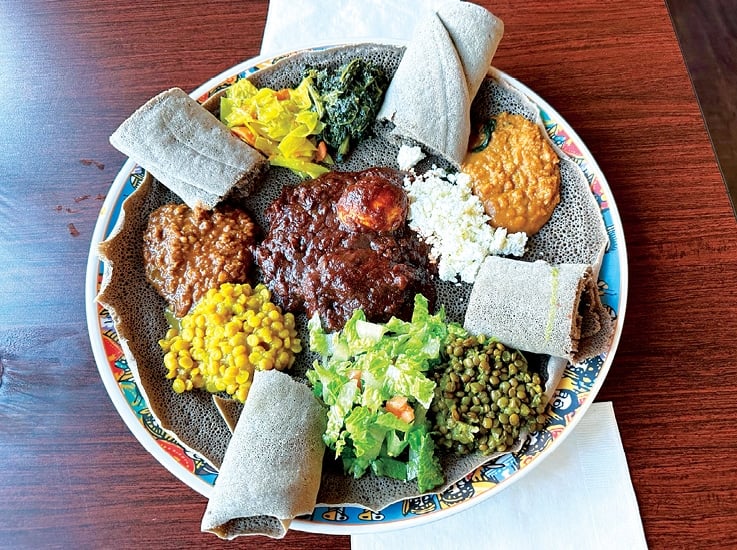
The vegetarian combo is designed for two and includes Misir Wat (spiced red lentils), Shiro (a chickpea stew), Gomen (collard greens), marinated cabbage with carrots, a beet salad, and Alicha Kike (split pea stew). It was good, and a slightly different combination than some other combos, including no American style salad that shows up at some of the restaurants. The presentation the food was one of the better and more aesthetic ones.
The default injera was not 100% teff, so not gluten free. It cost us $1 (each) extra for teff injera.
We observed there was a full bar and a small stage and sound system suggesting live music. And we understand there is a buffet style brunch on the weekends.
Agelgil charged a non-cash fee (3.5%) for using a credit card (but does not advertise that in advance). They refunded it when we paid cash.
We enjoyed a leisurely lunch at Agelgil and would go back except that we prefer a few others. There was incense burning but it was not overpowering.
Right across the street from Agelgil is Ras Dashen, 2801 East Cherry, 206.709.7626, https://rasdashenseattle.
com/about-us/, which is named after the highest mountain in Ethiopia. The outside of Ras Dashen was unassuming, but we were impressed that it had the cleanest, brightest interior (and bathrooms) of all of the establishments we visited. And they were the only one that provided hand sanitizer at every table which seems appropriate given that one eats with one’s hands. We were told that although Ras Dashen has been there 19 years, the new managers in the last two years have emphasized its appearance.
The Doro Wot very good, and was our favorite of the five establishments we visited. We could taste the chicken, but was only slightly spicy compared to the others. It came with two drumsticks which was convenient for sharing.
We ordered the Fish (Tilapia) Goulash and it was very good, our favorite of the fish dished we ordered for this article. The fish cooked just right with lightly crispy outer and still moist on the inside. The pieces of fish were the largest of any of the fish dishes we ordered.
The food served family style came with what we consider a Western (lettuce and tomato) salad and Ethiopian Cottage cheese. The cottage cheese is drier and more flavorful than what one might be accustomed to from what we buy in a local grocery store and it is a common accompaniment or side dish. We also ordered a side of collard greens (“Gomen”) to compare with other restaurants. We found it overcooked compared to others we tried, our one disappointing part of our visit to Ras Dashen. The standard injera was not 100% teff or gluten free; we paid $1.50 per injera extra for gluten free.
Ras Dashen appears to have a full bar, but we did not see any indication they host live music or other entertainment. They also had a non-cash fee of 3.5%.
We enjoyed Ras Dashen and will not hesitate to return despite the disappointing Gomen. We detected no incense.
Capitol Hill
 You have probably noticed Queen Sheba, 916 East John, 206.322.0852, which sits across from the main entrance to the Capitol Hill light rail station. It has been there for 19 years but there has been an ethnic restaurant in that location for decades, we believe back to the 1970s, at least. It has a much bigger interior than would appear from the street.
Queen Sheeba was slightly more expensive and had smaller portions than the other restaurants we visited, but it was liberal with the injera at no extra cost. One must ask for gluten-free injera and they may not always have it. But it was no extra charge when we got it.
This is the only restaurant where our entrees were served on separate injera, each accompanied by a vegetable, lentils with the Doro Wot and okra with the fish.
The Doro Wot was a smaller portion than we had become accustomed to, with one leg, but larger but no egg. (They were out of eggs but did not volunteer that, we had to ask). The Doro Wot was not that spicy even though listed as spicy.
The fish (tilapia) dish, Asa Wot, was slightly spicy, but was much more sauce than fish. It was heavy on the onions, not on the fish.
Our meal at Queen Sheba was acceptable, but, unless location were critical, we would return to one of the other restaurants we tried instead. We detected no incense.
North End
Adulis Eritrean and Ethiopian Restaurant, 10515 Greenwood Avenue North (just North of the five-way intersection with Holman Road), 206.920.5973, https://adulisrestaurant.com/. We went to Adulis for a mid-week lunch and we were the only patrons there. We tried the Doro Wot, a minced lamb dish, and a minced fish.
One way in which Adulis set itself apart was we were given a bottle of water each when sitting down (as opposed to a glass of water) without charge for the water. And they liberally offered more bottled water through the meal. They were also liberal with the injera and offered more without charge, including extra fresh injera to go with our leftovers.
The Doro Wot at Andulis was slightly spicy and was our favorite of the three dishes we tried, although not our favorite Doro Wot. The Asa Dulet (minced tilapia) was good, and also slightly spicy; the fish was definitely minced into small pieces and sometimes hard to distinguish from the sauce around it. Of the three establishments where we sampled a fish dish, this was the only one where we might have doubted the freshness of it. The Adulis Lamb Tibs (lamb cut into small pieces) were mixed into a very savory sauce, but we could not taste the lamb. The dishes were served with Gomen (collard greens) a green salad, with tomatoes and jalapeño peppers also on the platter.
Adulis was cave-like, and the food presentation was the least aesthetic of any of the establishments we visited. They have a full bar in back, and a hookah room downstairs. They host live comedy Wednesday nights, and live music weekend nights. This is clearly an evening-oriented venue.
The incense in the restaurant was heavy, even early in the day.
South End
There are a few more clusters of Ethiopian and Eritrean restaurants as one travels South on Rainier. Luckily, because we were trying to check out one we had been told was someone’s favorite, Delish Ethiopian Cuisine, only to find it was not open for lunch the day we were there (our mistake, lunch on weekends only), and there were other good choices within a one block radius. This is how we happened upon Massawa Eritrean & Ethiopian Restaurant, 4411 South Mead Street (just off Rainier South), 206.402.5542, named for a city in Eritrea. From the outside it did not appear open, with the chairs still on the tables at lunchtime; we were the only customers, but we have not found that unusual for a weekday lunch at these restaurants. We were very pleasantly surprised once the food arrived.
Doro Wet (as spelled at this restaurant) was flavorful and a little hot. It came with one small thigh (not enough for sharing) and was a smaller portion than most. It was good but not our favorite rendition of this dish. The veggie combo, on the other hand, was very good and probably our favorite among the restaurants where we ordered one. The presentation had the Doro Wet served in the middle It included Shiro (spicy garbanzo beans), Gomen, Misir Wet (spicy lentils), Kiki (yellow split peas), Alecha Lentis (lentils) Alecha Cabbage (a cabbage and carrot dish), cottage cheese, and a western lettuce and tomato salad. This was our favorite of the veggie combos we had ordered and a very nice presentation.
We were the first diners there. One benefit of that was they did not start burning the incense until just before we left. It appeared this establishment would be heavy on the incense if one arrived for a late lunch or dinner. The menu included breakfast and we noted an offering of spaghetti for breakfast, perhaps a throwback to pre-world war two times when Ethiopia and Eritrea were Italian colonies.
Overall
We had similar menus at all five of these restaurants in a short period of time, so we were able to determine a favorite two: Ras Dashen in the Central District, despite what we considered to be overcooked Gomen, and the surprising Massawa in the South End. Ras Dashen had our favorite Doro Wot, and our favorite fish dish. Massawa excelled in its vegetable combo. Both of these restaurants are located in clusters of Ethiopian restaurants; perhaps the close competition helps keep the quality up.
From our observation all of these restaurants are fairly empty for weekday lunch and/or early dinner. Many appear set up to be like night clubs with evening entertainment (and thick air due to incense). That is one aspect we did not check out, but you may wish to do so to get a more complete experience.
Dining Out is brought to you by Christopher Howard, now retired from law firm life, but still dining out, together with friends and family who help chose and sample the restaurants. Send comments and suggestions to him at chh@f2t.com or 206.669.5956.


