Profile / Alisa Brodkowitz: Aviation Attorney and CEO of Lightning Law Technologies
By Sarah Hogate Bacon
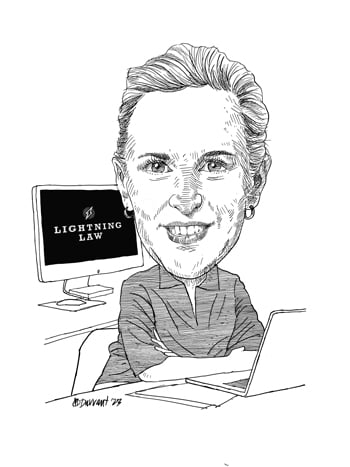 Alisa Brodkowitz grew up on a sheep farm in Vermont close to the border with Quebec, which is how she learned French. She loved “fixing things” that broke on the farm because that usually meant taking stuff apart and figuring out how it worked. Nestled in the remote mountains of the Northeast Kingdom, Alisa attended a tiny elementary school (started by the town doctor) where the kids were taught to be world citizens, learned Latin, designed their own kites and down-hill skied daily in the winter. Alisa left her equally tiny high school in the final semester to attend Lycée in France and study art.
After graduating from Concordia University in Montreal Brodkowitz was awarded a partial scholarship to Seattle University School of Law, where a course on International Civil Litigation set her career trajectory. The course was taught by an adjunct professor who had worked on the TWA flight 800 crash that exploded twelve minutes after takeoff from New York bound for Paris. The professor used the case as a template to teach about conflict of laws and international treaties.
It was the first time as a law student that Alisa found herself researching beyond the required reading, studying photos, aircraft design and international law. What caused the plane to crash, terrorism or equipment failure? If equipment failure, which plane parts? What evidence was still missing? Why were each of the passengers and crew compensated so differently? Which international aviation laws applied? Would they find a cause in time to prevent another Boeing 747 from exploding?
While seeking a third-year internship in aviation and international law Brodkowitz was offered the unusual opportunity to work at the Hague Conference on Private International Law, a prestigious intergovernmental treaty-making organization. This dream-come-true was almost immediately crushed; her law school wasn’t equipped to let her go. They had never had a student participate in an international internship and could not perform a “site visit”!
Fortunately, however, Alisa mobilized several of her professors to support her cause, including her international law professor who offered to “meet” with her weekly using a new technology called Microsoft Instant Messenger. The school eventually agreed. While working in The Hague and monitoring an international treaty, Alisa concurrently attended Leiden University School of Law in The Netherlands where she took classes in aviation and space law.
Soon after Brodkowitz returned to Seattle and took the bar exam the Seattle community was devastated by the crash of Alaska Airlines 261. Alisa was hired by a local plaintiff’s law firm to work on the case. Her first day as a lawyer at the firm a paralegal who normally performed transcription called in sick and Alisa was asked to type up the contents of a Dictaphone recording for a partner.
Determined to make herself indispensable, Alisa performed the task at hand, but she despaired all afternoon that those years of schooling had been in vain. That evening Alisa realized that she should be a terrible transcriptionist and a great lawyer and in particular, a rainmaker. She jumped at every opportunity to present at CLEs, write articles, share her unique knowledge of aviation law, and turned to technology to assist wherever possible.
Six years later Alisa started her own law firm. Initially she polled her clients on what they keyed into their search engines to find her, bought the URL “www.injuredonaflight.com” for $.99, and started a blog. She created Excel spreadsheets to automate operations and track effort input versus outcomes and splurged on an early e-discovery platform to manage production, surpassing its intended functionality by converting the platform into a personal document management system. The firm grew as she took on more and more plane crash cases outside of Washington and continued to scale.
Over her twenty-two years of practice, she has worked on dozens and dozens of plane crashes, some better known than others. At one point while flying to a crash site in the same make and model as the crashed aircraft, Alisa suffered a panic attack, which she later attributed to having looked at the photos of the crash scene and read the witness statements while in the air. Luckily that fear was fleeting and soon replaced by a passion for flying born of a deeper understanding of how airplanes and helicopters operate. Aviation law, representing crash victims around the world, and fighting to make flying safer was deeply satisfying work.
The work also came with a lot of travel and by 2017 the travel had taken a toll. In the midst of a divorce, Alisa wanted to be closer to her then four-year-old and ten-year-old daughters, yet she had upcoming depositions against Airbus in France. At the time remote depositions were somewhat accepted but not with large quantities of documents common to plane crash cases, including flight manuals and maintenance records, multiple defendants, and counsel. So, Alisa began an experiment with the available technology. At depositions she normally found herself passing out the same documents that had been produced to her electronically by the very people she was reproducing it to. To boot, it often took a paralegal a whole day to print enough copies for everyone and organize--an unsustainable waste of time and paper.
With the next deposition at her office, Alisa decided to send around an email a few days before informing participants that all exhibits were available in a Dropbox. She told the other attorneys that the witness would have an iPad with the exhibits uploaded. The attorneys could either bring their laptops or print the voluminous exhibits (at least two Bankers Boxes) ahead of time if they wanted hard copies.
To Alisa’s surprise all five counsel brought their laptops for the “paperless deposition.” Alisa used the same file name as the counsel had when producing the files digitally and called that file name out when introducing an exhibit. She gave the stenographer her own drive of documents and a printout of the file names to physically paste exhibit stickers to once a document had been used.
And there were some unexpected bonuses with Alisa’s new hybrid system: when questioning the witness, Alisa was able to “control F” in a document to find contradicting terms; all the attorneys agreed to authenticate the documents at the deposition since they were the very same ones they had produced; the deposition went faster, there were no “blurry copies,” and the conference room was nearly paper free. All of that prep time and standing in front of a photocopier in tedium was gone. The other attorneys, from New York City, had Bankers Boxes of documents Fed-Ex’ed to her office to continue their slower questioning of the witness after her direct.
Other attorneys began asking Alisa to give presentations on how to take paperless depositions, but the available technology had limitations. For example, you could not annotate exhibits or determine which electronic documents were originals, among other problems, and how would this work with a remote video deposition? Brodkowitz began to dream up the perfect piece of software for remote depositions. It would be DropBox integrated with Zoom, with features lawyers actually use like showing a document but not making it available for download or printing, drawing on documents and saving those anew, obtaining signatures, all in a manner that replicated the real workflow of a proceeding.
In 2018, after obtaining a $40 million joint settlement representing a victim of the helicopter crash near the Seattle Space Needle, Alisa decided to start Lightning Law. She vision-boarded her ideas and hired developers to start building the software. A year later, when traveling in Ethiopia and Kenya to work on the Boeing Max crashes, Alisa witnessed firsthand how difficult it was to get to court in countries that lack infrastructure. Traveling over dirt roads takes a long time and in other countries courts sometimes close at unexpected times.
By contrast in Africa, she also saw people paying for goods and services and buying phone airtime using their mobile phones (the M-Pesa platform), which got Alisa thinking about true justice as a matter of access. The vision for Lightning Law crystalized: access to justice means moving justice online, first onto our computers and then onto our mobile phones. Lightning Law filed for its first patent describing a new way of integrating documents with remote video conferencing and with that, what had begun as an idea for remote depositions became a dream of online justice, with everything that we do for all clients, as attorneys, mediators and judges, in all legal proceedings and meetings, online.
Then COVID hit. Courts closed and it became immediately apparent to Alisa that the world needed Lightning Law. With the worst global pandemic came some promising access to justice reform. Courts moved to Zoom trials with more diverse juries composed of citizens who could participate from home. Mediators began conducting mediations online. Arbitrations moved online. Many attorneys began practicing from home. This progression helped Lightning Law raise funds, attract valuable co-founders, advisors, and gain traction.
Lightning Law then created Consult, where attorneys could meet remotely and securely with clients and work with their documents in a manner that preserves attorney client privilege. They created Mediate, now being used even in Canada, for online mediations, complete with offer and demand tracking, online payment of mediations and real time mediation agreement drafting.
Recently Lightning Law’s utility patent was approved, and the company was approached about an exciting new opportunity, to create a product designed for incarcerated individuals which allows them to speak with their attorneys and review discovery via tablet. The product, called Due Process, may soon be able to thousands of justice-impacted individuals. Alisa believes it is only a matter of time before Lightning Law is available in courts nationally for remote hearings and trials.
While growing Lightning Law is invigorating, Alisa never wants to stop practicing law. She takes on a small handful of aviation cases every year so that she can apply what she has learned after decades in her niche practice area. She loves taking depositions, appearing in court, the technical challenges of product cases and litigation strategy.
During the pandemic Alisa began to split her time between Seattle and Arizona. Using Lightning Law she practices remotely as of counsel for Schroeder Goldmark and Bender. A former president of King County Washington Women Lawyers she enjoys mentoring other female attorneys and would love to see more female legal technology founders.
Her advice? Identify the gaps in technology in your own practice and play with as much technology as you can. Her predictions? Email for attorneys may soon be replaced and virtual reality courts are our future.
Sarah Hogate Bacon is an activist, writer, and rare disease patient and advocate. Her work has run in The Atlantic, New York Magazine, The Washington Post and Fast Company.


