By Sidney Tribe
Neal Black’s roots in Pacific Northwest’s forests run deep. Fittingly, his favorite adage is “Society grows great when people plant trees under whose shade they know they’ll never sit.” Neal has spent a lifetime in law and policy, learning to see the forests, see the trees, and plant new ones.
Neal’s roots are in Prineville, Central Oregon’s oldest town. For decades, Prineville relied on timber sales in the surrounding Ochoco National Forest for much of its economic strength. Prineville was home to four generations of Neal’s family. His grandparents and great-grandparents migrated to the high desert of Central Oregon from Missouri and Iowa. He cherished having multiple generations of family so near. He went to Crook County High School, where his parents and all but one of his aunts and uncles also attended. Crook County was the only high school for a rural county that stretched over 100 miles of sage brush, juniper, and ponderosa pine. The mill owners’ kids and the mill workers’ kids, the ranch owners’ kids and the ranch hands’ kids, the teachers’ kids and the janitors’ kids — they all grew up together in one tight-knit community.
Neal originally planned to attend Oregon State University and only applied to Stanford because the school mailed him an application after seeing his test scores. He didn’t even know exactly where Stanford was located. But by the fall of 1990, he was on campus, studying civil engineering and hoping to be an architect.
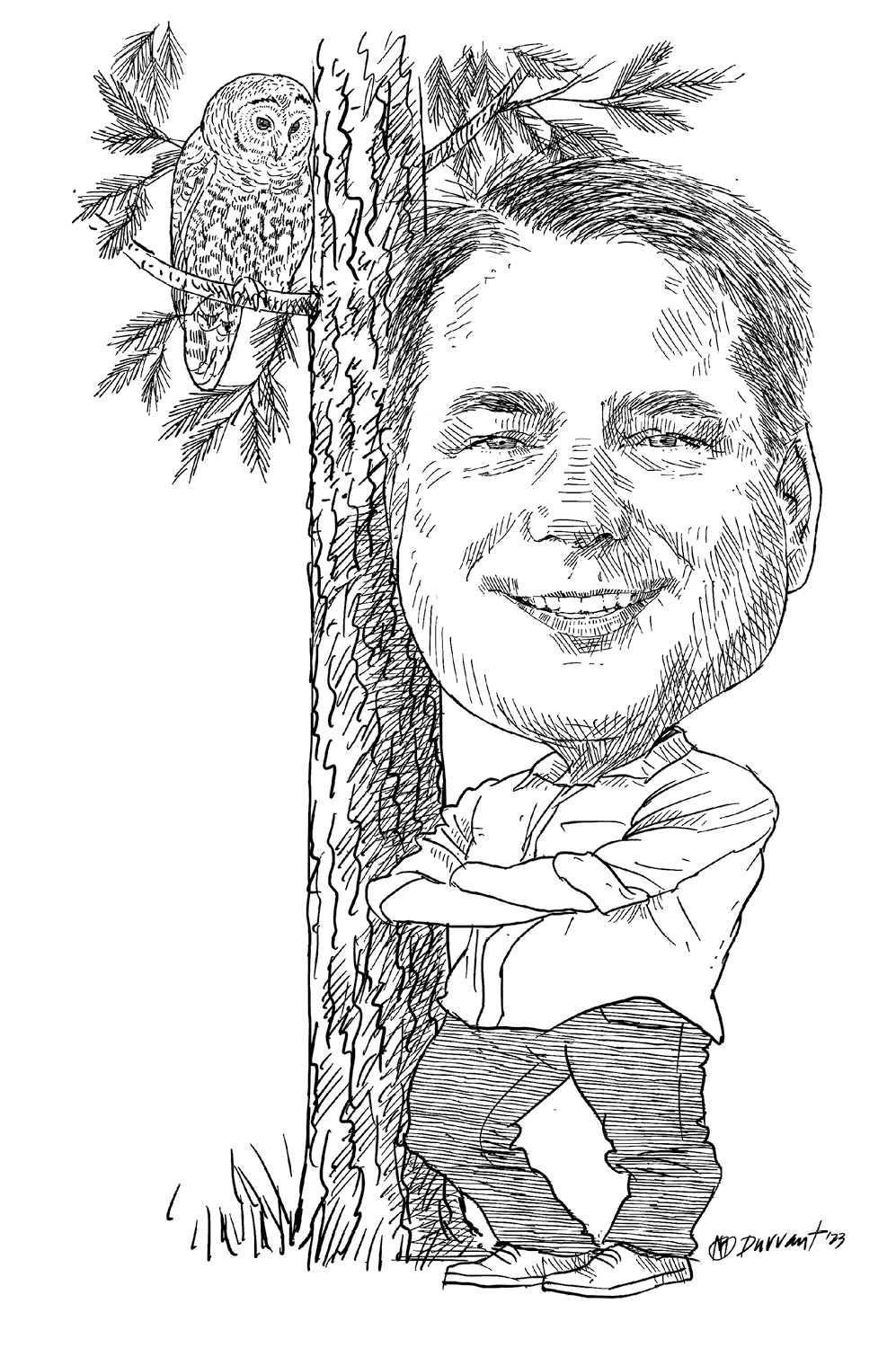
But fate, as it often does, intervened. During Neal’s freshman year at Stanford, he got hooked on law and policy as a result of what is famously referred to as the “spotted owl controversy.” Judge William Dwyer, a former KCBA President (1979–1980), enjoined timber sales in the national forests of the Pacific Northwest to protect the habitat of the endangered northern spotted owl. The injunction would remain in place until the Forest Service updated its Forest Management Plan to comply with the National Forest Management and Endangered Species Acts.
The decision devastated Neal’s hometown. Four of Prineville’s five sawmills relied almost exclusively on sales of timber from public lands. Unlike large timber companies headquartered elsewhere in Oregon and Washington, Prineville’s mills did not own large tracts of private timber. All but one of the mills closed by 1994.
Months after Judge Dwyer issued his injunction, Neal found himself taking a course called Environmental Science and Technology as part of his civil engineering curriculum, taught by a wildly popular Stanford professor, Gil Masters. It was an introduction to the causes, effects, and methods of controlling environmental degradation, including global warming, ozone depletion, urban air quality, and hazardous waste management. Despite the immense toll that environmental law and policy had taken on Neal’s hometown, he did not retreat into resentment about the subject. He was able to appreciate that wild places are scarce and fragile, while also acknowledging the direct effects of environmental law and policy on his hometown.
After studying the causes and effects of environmental degradation, Neal was hooked. He was no longer interested in architecture. Within 18 months of arriving on campus, he became passionate about environmental law and policy. He graduated from Stanford with a new career trajectory focused on environmental law and headed to a premiere law school for that pursuit: Georgetown. Almost all of his elective courses and activities were related to the environment. He was a law clerk and intern for the Environmental Defense Fund, the Environmental Defense Section of the Justice Department, and the Institute for Public Representation at Georgetown. With the IPR, he proudly worked to support the efforts of the Anacostia Watershed Society to make the Anacostia River in Washington, D.C. (one of the most polluted stretches of river in the U.S.) habitable to fish, birds, and people. He even organized a litter patrol on the streets of Capitol Hill near the Georgetown campus.
Upon graduation, the realities of being a first-generation college and law graduate set in. He married his partner, Joanna Black, now General Counsel at Seattle’s Madrona Venture Group. The two met in college and began building a life together but had significant educational loans. Neal felt that pursuing environmental policy in government or non-profits was impractical. He got a job at Seattle’s largest firm, Perkins Coie, and tried his hand at litigation. While at Perkins, he tried his first and only case as second chair to then-junior-
partner James Williams. Incredibly, Neal’s only jury trial was held before none other than Judge Dwyer. There he stood, arguing preliminary motions before the same judge that had protected the Pacific Northwest’s old-growth forests but who, in doing so, also ushered in a decade or more of hardship for Neal’s hometown. Neal learned from Judge Dwyer’s integrity and dedication to the rule of law the need to consider the importance of broad public policy and also the individual people and places that policy impacts. He learned — in law and policy — to see the forest and the trees.
Over two decades later, Williams, now the managing partner of Perkins’s Seattle Office, praises Neal in strikingly similar terms to those Neal has used to praise Judge Dwyer: “Neal is a man of principle. Extraordinary. Fearless and straightforward. Few lawyers possess the same courage of their convictions and integrity.”
Neal’s career path soon moved from litigation to business law. He worked at the Kirkland office of Wilson Sonsini Goodrich & Rosati, Silicon Valley’s largest firm. He was Vice President and General Counsel for Square Enix, a Japanese-based interactive media company. Since then, he’s either been a VP/GC at companies in the games industry or partner in a boutique law practice doing transactions for companies in software and media.
But Neal never abandoned his interest in public policy. For example, having grown up in a family that owned rifles and hunted for food, not sport, he was concerned about the growing prevalence of handguns, military-style rifles, and large-capacity magazines. When he was young, owning and brandishing such weapons was seen by people in his rural community as irresponsible and clownish. As an adult, he became concerned about their increasing role in mass shootings, completed suicides, and domestic violence.
In 2006, Neal’s interest in reducing gun violence led him to join the Board of Trustees of Washington Ceasefire, advocating for common-sense gun-safety legislation. While at Ceasefire, Neal reconnected with a former Perkins colleague and future KCBA President Joe Bringman (2011–2012), who encouraged Neal to join KCBA’s reconstituted Public Policy Committee. Not long after that, the Public Policy Committee and the Board of Trustees publicly supported the 2014 passage of I-594, which mandated universal background checks on all Washington gun sales. By 2016, Neal was chair of the committee and was meeting scores of Washington lawyers and legislators doing incredible work in law and policy. In 2018, Neal was asked to fill a vacancy on the KCBA Board of Trustees and was later elected. He has served as a trustee for 4-1/2 years. He has many interests with KCBA but is particularly committed to its public policy advocacy and civil legal aid.
In 2019, Neal stood at the crossroads of the practice of law and public policy: as an actively practicing lawyer, he ran for elected office on the Kirkland City Council, where he and Joanna have lived for 25 years. He won an open seat for a partial 2-year term with 71% of the vote. Two years later, in 2021, he won re-election for a 4-year term with 73% of the vote.
Neal is proud to work with his Council colleagues on Kirkland’s broad policy goals, including encouraging development of a greater mix of housing types, especially for middle- and low-income families; innovations in the response to those experiencing behavioral health crises and homelessness; successfully providing real-dollar relief and recovery to Kirkland’s business owners, workers, landlords, and tenants throughout the pandemic; encouraging development in Kirkland of more walkable, sustainable neighborhood centers; and balancing two successive biennial budgets that have responded to the crises, increased the levels of service to Kirkland’s residents, and maintained the city’s AAA credit rating.
Finally, and fittingly, Neal has helped Kirkland craft a new tree code that will preserve more of the urban forest canopy while balancing the need for more housing.


