 From the Desk of the Presiding Judge
By Judge Averil Rothrock, King County Superior Court Presiding Judge
Court Operations: Successes, Challenges, and the People Behind Them
Aren’t we fortunate in King County to benefit from the work of so many public servants and legal system participants striving to improve the lives of our community members? The efforts of so many in our community inspire me. Every day each of us makes a choice about what kind of community we are—giving to others, thinking of others and considering how our actions impact others. I’ve always loved being part of a profession, as opposed to simply reporting to a job. The law can be imperfect, but it also offers our greatest hope for stability and equality. I am grateful to be part of this community and to work alongside all of you to support and improve the rule of law.
I recently found myself before the Law and Justice Committee of the King County Council to present on the state of King County Superior Court. I had accepted the gracious invitation from the Committee to present an overview of current operations, including successes and the challenges before the Court. Thus, you can imagine that data would be presented, and I will share that data with you in this article. Before diving into that data, I took the opportunity to speak about the people who perform this work.
Our Court, a co-equal branch of government with the King County Council, functions thanks to a broad array of employees who believe in justice and the civil resolution of conflict based on fair application of rules and laws. Everyone who works at the Court is a member of the King County community. We walk our dogs on the same streets. Our children go to schools here. You will see us shopping in local grocery stores. We recognize that our jobs are made possible by the trust the public places in us.
You might immediately think of the Court as comprised of 56 elected judges and 13 commissioners. Yet, the Court cannot deliver our essential services, hold the hearings, oversee the trials and welcome the community into our courthouses without the support of our 385 committed employees. Together we strive to fulfill the Court’s mission to equitably serve our diverse public by administering justice in accessible, inclusive, and unbiased forums.
Happily, we welcomed on February 23 a new judge to the Superior Court bench, Daniel York. Governor Ferguson appointed Judge York to Department 32 in January. This department became vacant upon the retirement of Judge LeRoy McCullough last December.
Judge York brings considerable legal expertise and experience to the role of judge. He has served as a Family Law Commissioner Pro Tem in King County and at the time of his appointment he was the current Chair of the King County Bar Association’s Family Law Section. Judge York is also a United States Marine Corps veteran who served in Iraq and Kuwait. His deep experience with Family Law will be instrumental in his first assignment to our Unified Family Court Department. With this assignment, the Court increases the number of judges assigned to Unified Family Court by one, so we now will have nine judges doing this important work overseen by UFC Chief Aimée Sutton. Judge Sutton is overseeing a pilot project to begin in March to add an afternoon family law motions calendar to reduce the swell of these calendars.
Based on his call to public service, Judge York joins his 55 colleagues on the largest trial court in Washington—one with a significant workload. In 2025, 58,711 cases requiring judicial action were filed in Superior Court.
Workload by case type
Members of the KCBA likely appreciate that while criminal cases can be more visible, most of the cases that come to the Court are civil matters. Civil cases make up 49 percent of the filings in King County Superior Court in 2025. Criminal cases, by contrast, make up 9 percent. You can see our workload by case type in Figure A.
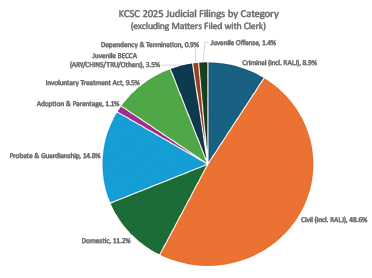
Figure A
Civil trends
A climb in the number of filings for civil protection orders is among the most persistent trends in civil filings. These filings drive the need for increased hearing calendars and hearing calendar coverage within legislatively proscribed timelines. You may be interested to know that, when we drill down on the numbers, we find that filings for domestic violence protection orders have remained relatively constant over the last 6 years, while filings for anti-harassment protection orders specifically have increased. Overall, there has been a 309 percent increase in anti-harassment petitions since 2019! Figures B and C show filings of Civil Protection Orders and a breakdown by type.
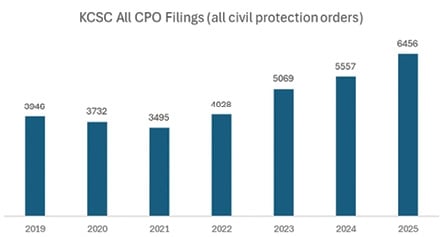 Figure B
 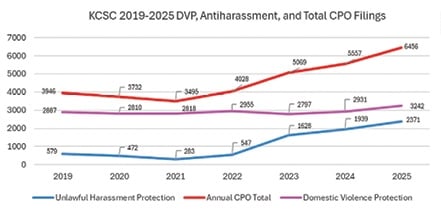 Figure C
Fortunately, the King County Council provided funding in 2025 so that we could add two new commissioners to handle all civil protections orders.
Another type of civil matter that has also seen a dramatic rise is unlawful detainer filings, commonly known as evictions. These filings have risen sharply since 2021, and it appears that this record high level of filings constitutes a “new normal” for the Court. See Figure D. As with Civil Protection Orders, we have been able to address this increase with the needed influx of judicial officers thanks to increased funding from the King County Council. The Court added two additional judges in 2024 and a new housing commissioner this month. With the application of these resources the Court successfully eliminated a backlog and are timely hearing these matters. 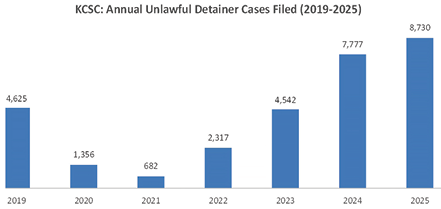
Criminal trends Figure D
A central question in managing the flow of cases into Superior Court is deciding what must happen when. Criminal trials have an important impact on everything in Superior Court because Constitutional requirements mean they take priority over civil trials. Each week, the Court determines which cases are ready for trial or hearing and assigns them to judicial officers. Our challenge is to provide timely, meaningful access to justice for everyone with a matter before the Court, while upholding the requirements of the Constitution. Other cases have statutory priority as well, including dependency matters and hearings pursuant to the Involuntary Treatment Act. The Court prioritizes matters involving children, including UFC trials requiring parenting plans, and gives consideration to matters that require an interpreter, involve aged and ill litigants, and other circumstances. We do this prioritization fully aware that all litigants deserve their day in court and need timely justice—including those alleging a harm that requires a remedy.
Regarding criminal trials, I was pleased to be able to share with the Council that the Court—together with the King County Prosecuting Attorney and the King County Department of Public Defense—cleared a backlog of criminal trials that accrued during the pandemic. You can see the Year-End Pending Criminal Cases statistics at Figure E. We are back to pre-pandemic levels of pending criminal cases. I thanked the Council for their support that helped us reduce the criminal backlog and noted that complex and serious felonies have the longest time to resolution within this category of cases.
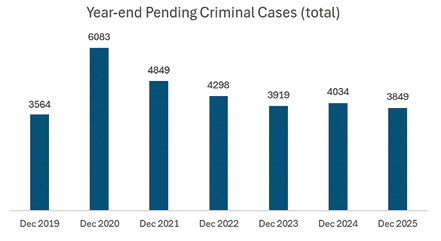 Figure E
Remote proceedings, e-filings and IT Support: They Go Hand in Hand
One of the biggest advances in access to justice is the ability to conduct proceedings remotely using video. This innovation was in a pilot project in Superior Court during the onset of the COVID-19 pandemic. It greatly enhanced our ability to preserve and even expand access to justice during one of the most challenging times in the Court’s history.
Since then, remote proceedings have proven revolutionary for courts. In King County Superior Court, they have improved the court user’s experience, enhanced efficiency, and expanded capacity. Remote proceedings enhance our flexibility, enabling matters to be heard regardless of physical location or assignment of the judicial officer. We have remote jury selection and jurors love it. We also are constantly improving our remote filing and service systems in partnership with the Clerk’s Office.
Now that we have set this high level of service, our challenge is to sustain it without the COVID-era funding that first supported it. Our IT infrastructure includes more endpoints, like video monitors and laptops, than ever before. As our technical capabilities and our network expands, we must have a minimum number of IT staff to support the growing number of endpoints and maintenance work.
Strategic advancements
You may recall hearing about the Court’s Strategic Action Plan in prior articles. Embracing technology innovation is an example of the Court’s commitment to continuous improvement. Other examples of recent accomplishments include the Diversity, Equity, and Inclusion (DEI) training we held for staff, an evaluation and improvement of Human Resources practices with a DEI lens, assessing and improving our compliance with the Americans with Disabilities Act (ADA) including regarding our website accessibility, updating our Continuity of Operation Plans for cybersecurity, and addressing policy guidance and training on the use of artificial intelligence by personnel.
Facilities
We must do the work before us while planning for the work of the future. And planning for the future requires collective effort and the ability to take an exceptionally long view. That is why I encouraged the Law and Justice Committee to imagine the people who will rely on King County Superior Court in the future. The Court is situated in aging infrastructure in the King County Courthouse and the Maleng Regional Justice Center. Will future users be able to access justice in a courthouse that is able to accommodate their needs? Where will their courthouses be and what will they look like? How will the courthouse mesh with required detention facilities that are safe, conducive to well-being and support efficient operations and transport from detention to courtroom? I anticipate strong future collaboration with the Council regarding these planning needs, and all of our joint efforts to provide access to justice in King County.
Speaking of our physical space, you should all know that the downtown KCCH courthouse recently enjoyed the opening of a coffee shop just inside the 3rd Avenue entrance to the King County Courthouse. Check out the City Grind Espresso Café, open from 7:30 a.m. to 3 p.m. It’s a welcome addition!
Citizens prioritize justice in their communities. Courts create space for it. These spaces, both physical and virtual, deserve our attention and care. They influence our ability to adapt to trends regarding the types of cases we see and the people we serve. These spaces must be renewed and remade continually, so that they are truly open to all.


