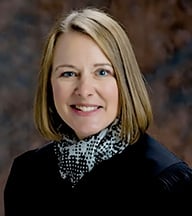
 From the Presiding Judge: Introducing the New Presiding Judge of King County Superior Court
By King County Superior Court Presiding Judge Averil Rothrock
Every day, decisions are made in King County courtrooms in real time by real people doing their very best under significant pressure to determine important issues of liberty, family relations, property, safety, recovery, accountability, and dignity.
As practitioners and members of our legal community, you know the myriad of matters on our calendars daily, and you appreciate the profound consequences they hold for the individuals involved.
It’s an honor — and, I will admit, a humbling experience — to step into the role of presiding judge for the King County Superior Court. Allow me to introduce myself, for those who do not know me.
I am a lifelong resident of Seattle and King County and graduated from Garfield High School. I’ve recreated all over the area (soccer was a favorite but, alas, I’ve hung up my cleats) and spent plenty of time on the sidelines as a parent-fan. The natural beauty of the region is in my bones.
I was fortunate to enjoy over 24 years of private practice, first litigating civil matters in the trial court and then focusing on appellate work. I loved practicing law! Along the way, I decided to devote the rest of my professional work to the public. This dream came true when Gov. Jay Inslee appointed me to the bench in 2018. Since joining Superior Court, I’ve served downtown, at the Judge Patricia Clark Children and Family Justice Center, and in Kent at the Maleng Regional Justice Center (MRJC).
The presiding judge does not act as a super-judge (a relief to everyone, especially me). Instead, the role of the presiding judge is to oversee the court’s self-governance, perform court administration, make departmental assignments, coordinate with justice system partners, and ensure that the court as an institution fulfills its constitutional and statutory responsibilities.
My personal mission in this new role is to listen well and embrace innovation. While institutions are hard to improve, and individuals tend to resist change, by working together we can find the best ways forward to fulfill our commitments.
How the Court Is Structured
As a general jurisdiction trial court, the King County Superior Court handles a wide range of matters: criminal (including resolutions through treatment), civil disputes of all varieties and sizes focused on remedying alleged harm, family law focused on families in transition and — often — crisis, juvenile dependency and offense matters, probate, involuntary treatment, and specialized calendars designed to address particular needs.
King County Superior Court is one of the largest and busiest trial courts in the nation. It is organized into departments to which our judicial officers are assigned, including Criminal, Civil, Unified Family Court, Civil–Unlawful Detainer (created to meet the unprecedented number of unlawful detainers), Drug Court, Involuntary Treatment Court, Trials at the MRJC, Dependency, and Juvenile Offender. Notwithstanding these departmental assignments, we maintain flexibility and an all-hands-on-deck mentality to address the work any given week.
Your judicial officers include elected Superior Court judges and commissioners who are appointed to handle specific types of cases. While judges ultimately bear responsibility for judicial decision-making, our commissioners play a critical role in ensuring timely and effective decisions and case resolution.
None of this works without our professional staff — bailiffs, administrators, court coordinators, IT professionals, juvenile probation counselors, and many others — who keep the court functioning day in and day out. If the judiciary is the visible tip of the iceberg, our staff is everything beneath the surface that keeps the system afloat.
The presiding judge is elected by the judges. Our court is self-governing, and significant administrative decisions are determined by vote of the judges. An executive committee performs essential governance work. All the judges serve on committees with staff where our mission and values are put into action, including Budget, Courts and Community; Education/Training; Diversity, Equity and Inclusion; Dependency; Family Law; Jury; Local Rules; Ex Parte/Probate; Interpreter Committee; Sealed/Adoption Files; Involuntary Treatment Act; Personnel; Security; and Technology. The scope and importance of this committee work cannot be overstated.
Strategic Plan and Values
The Superior Court’s mission is “to equitably serve the diverse public by administering justice through accessible, inclusive, and unbiased forums for the fair, understandable, and timely resolution of legal matters.” The court organizes itself around a demanding set of values: fairness and timeliness, leadership, respect, accessibility, safety, public service, innovation, and collaboration.
I want you to know that these values are not slogans. They are operational commitments that shape how we assign cases, manage calendars, interact with the bar, and serve the community.
To implement the refreshed mission and core values, the Superior Court is determined to focus on four key areas through 2028: (1) enhancing the court user experience, (2) enriching the employee experience, (3) improving court facilities, safety, and security, and (4) being an adaptive, innovative, and responsive court. We are working on these goals, including through your support. At the end of 2026, we’ll return to this topic and the progress we’ve made.
Independence of the Judiciary
Whatever the national and international headlines of the day, we as a community are most directly impacted by our local government. That includes our state and local courts.
Our judges must decide cases free from political pressure, public clamor, or personal preference. Thanks to all of you who are speaking out about the importance of an independent judiciary and speaking up when you see the judicial branch undermined unfairly. Personal attacks and disparagement are wrong and damaging to the justice system as a whole. We must work together to protect judicial independence, which is not a catchphrase, but is essential to the constitutional functioning of the judiciary.
Your Ideas and Feedback
One of the best ways I can work towards the court’s mission is to receive feedback and ideas. I will continue the tradition of attending monthly meetings with your president and executive director and working on a collaborative and informative Bench Bar Conference in November.
The KCBA has been a key to my professional development and career satisfaction, including through my long membership in the Appellate Practice Section. I had a long tenure on the Board of Trustees for the King County Bar Foundation. The work of the Bar is inspiring, and I look forward to collaborating in this new capacity.
Like my predecessors, I believe your know-how and familiarity with court processes are important barometers. I plan to get out there throughout the year and hear from you, and to establish more channels for communication. I hope you’ll share ideas for improvement, along with recognition of what we’re doing well.
Serving the Public
Courts exist for the public, not the other way around. My colleagues believe in our public service mission, and I am proud to stand among them. We are committed to treating every person who enters our courthouses with dignity, whether they are a litigant, juror, lawyer, witness, staff member, or person lost on the wrong floor.
Accountability means that we must scrutinize our performance, acknowledge where we fall short, and work to improve. Our trajectory is always forward. Let’s do this!


