Every November, a small involuntary flinch returns. Veterans Day arrives, and something in me contracts. It is a reflex made of regret, belated reverence, and the uncomfortable truth that, for years, I misunderstood the very people the day is meant to honor.
Now in my seventies, I understand more clearly what service demanded of the men and women I grew up around. Not the abstractions, the flags, parades, or dutiful recitations, but the human cost: responsibility, fear, endurance, and sacrifice. I think of the stories entrusted to me: a World War II POW diary kept by a bombardier’s navigator who was like an uncle to me; my other real “Uncle Lucky,” aptly nicknamed, who survived the savage mountain fighting in Italy with the 10th Mountain Division; a neighbor’s father who endured the Bataan Death March; an uncle who lost an eye; the judge I clerked for, and was an informal bailiff for, was a bombardier; my own father, serving in the Navy during the Korean War. His Navy fleece still hangs on my office chair.
My father-in-law, headed for the invasion of Japan before the atomic bombs ended the war, almost certainly owed his life to that abrupt turn of history. Later assigned to clear Japanese soldiers from caves and help with the post-surrender, he treated them with such dignity that some wrote to him for years afterward.
I think, too, of those who came home from Vietnam, some shattered, some steady, all changed. I remember my cousin’s friend who served beside him, corresponded with him, and later married his sister, who he initially only knew from those combat-wartime letter exchanges. And I remember the day I watched, via Zoom, as the brother of a good friend received his fourth star, briefly serving as Air Force Chief of Staff; this reminded me that principled military leadership still mattered.
Yet despite all those faces, I wince, because I did not serve. Many of us Boomers didn’t. We had deferments or lottery luck. My own draft number, an ominous 4, arrived while I was working in New York’s school district drug-
prevention program. I managed to return to college “just in time,” scholarships in hand, dodging what might have come next in Southeast Asia.
We protested the Vietnam War because we believed we had to. Friends I had were clubbed or arrested in Washington, D.C. Some became conscientious objectors. Muhammad Ali refused induction and lost his title and prime fighting years before the Supreme Court vindicated him. You didn’t have to agree with him to see the price he paid.
But in our earnestness, many of us aimed our anger at the wrong Americans. We treated returning soldiers as if they embodied the policies we opposed. Our fury should have been directed at the decision-makers, not the young men — the kids, really — who carried out the orders.
That truth hit me hard in law school in 1975. John Kerry, then a third-year student, occasionally joined our informal Friday gatherings. Soft-spoken, thoughtful, a decorated veteran who later led Vietnam Veterans Against the War, he made the distinction unmistakable: the protest was justified; the hostility toward veterans was not.
I heard a similar clarity decades later, in 2004, when a Yemeni high-school exchange student lived with my family after his sponsor bailed. When we asked why he would choose to live with an American — let alone Jewish — family, he shrugged: “People aren’t the problem. Governments are.” At 16, he already understood what had taken many of us years.
Maybe that long-buried guilt, over not serving, but more honestly, over how we treated those who did, shaped my decision to work at a police department before law school. Almost everyone there had served. Listening to them was its own education.
So each Veterans Day, I pause. I reach out to the veterans I know. I think about the countries where service is universal and essential, like Israel and Ukraine, and wonder whether we’ll ever build a world where war isn’t a default setting.
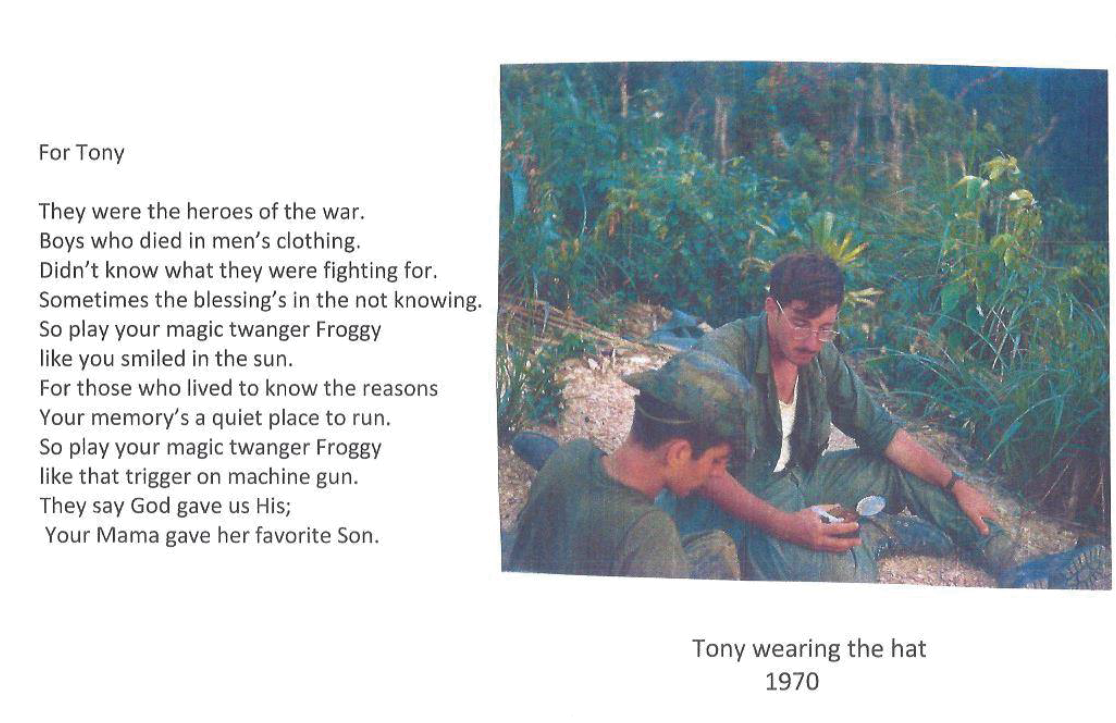
And I reread my cousin Danny’s poem for his friend Tony. They served together in Vietnam. Danny came home. Tony did not. The poem is a reminder that the freedoms we take for granted were carried, often quietly, on the backs of those who served, and especially those who never returned.
Each year, when I finish the poem, the flinch fades just a little — not because the guilt is gone, but because gratitude has finally learned to stand beside it.
Michael Goldenkranz is a long time Neighborhood Legal Clinics volunteer and has retired from daily practice.