 The big dark has settled in, and the atmospheric rivers are making a mockery of our umbrellas and Gore-Tex. Resistance is futile. It’s time to get cozy. Pull out the flannel, wool socks, steaming beverages, and a good book to sink into. In this month’s column, get some ideas for what to read as you nestle up next to the fireplace. Here’s a look at what the law library and foundation staff are currently reading.
“The Turner House” by Angela Flournoy
This book was chosen by Tamara Hayes, Technical Services Librarian. Tamara is responsible for every aspect of the collection including acquisitions, circulation, collection development, cataloging, and processing. She’s the glue that holds the library together.
I recently read “The Turner House” by Angela Flournoy. “The Turner House” explores the lives of the large Turner family. The Turners raised their 13 children in a little house in Detroit until the father passes away and the matriarch, Viola, has to move out due to her health. This book has all of the family dynamics: a sibling parenting younger siblings but struggling in their own life, younger brother jealous of older brother, and the youngest feeling unseen by the rest of the family. There’s much debate about what to do with the home after their mother passes away.
This book made me think of my grandmother’s home and how it’s a second home to all of my family members. You know that you always have a home at Nana’s, but what happens to the place when the person or people who’ve made it a home are no longer there?
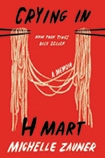
“Crying in H Mart” by Michelle Zauner
 This is former Outreach Services Attorney, Sarah deQuay’s pick. Sarah has moved on to greener pastures at the AG’s office but will always remain a beloved member of the KCLL family.
My most recent read was “Crying in H Mart” by Michelle Zauner, the lead singer of Japanese Breakfast. This book absolutely wrecked me, as it is a memoir that mainly focuses on the singer’s time caring for her mother battling terminal cancer.
Despite the story being heartbreaking, Zauner really ties in universally relatable topics like family traditions and expectations, food, and regret together in such a beautiful, lighthearted, and often funny way. Not to mention, the author uses the pain of losing her mother to inspire the music that ultimately launched her band into fame, which is just such a poetically human gut-punch.
I loved this book so much, I had to buy the band’s first album on vinyl for my new record player. The album even features a photo of Zauner’s mom in the cover art. After finishing this one, I definitely need a light, cheesy Christmas romance novel to help me emotionally recover!
“Project Hail Mary” by Andy Weir and “The Devil Reached Toward the Sky” by Garrett M. Graff
 If you’ve been to KCLL within the last 40 years, then you know Rick Stroup, our Assistant Director and recommender of the next picks. Rick would be forgiven for being resistant to change after almost 40 years on the job, yet surprisingly, he’s always the one to quickly embrace new technology, programs, and initiatives.
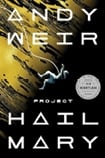
The “big question” in Andy Weir’s “Project Hail Mary” is this: If you were one of a very small group of people whose knowledge and genetic makeup could potentially save humankind from the next Ice Age, knowing the attempt could cost your life, would you do it? The less obvious question “Project Hail Mary” poses is: Can compassion, friendship, and commitment be universal values?
It’s a Weir novel, so 95% of the science is rock-solid. The remaining 5% is the thoughtful, clever, what-if science that makes even the hard science approachable. A hallmark of good science fiction is careful navigation of the genre’s numerous tropes. “Project Hail Mary” has its share of them — technology as human savior; the pesky reality of relativity and space-time. Life doesn’t have to come with two arms, two legs, and a longing for a tropical beach to be authentic. Weir manages to weave a plot that is intriguing, sad, humorous, and uplifting.
Pro tip: Read the novel instead of waiting for the upcoming film. I’m looking forward to it but skeptical that the film will capture the nuance and complexity of Weir’s story. It deserves more than flashy CGI and eye-candy, so here’s hoping.
Why would anyone want to read “The Devil Reached Toward the Sky,” a non-fiction book about the development and use of the first atomic bomb? Don’t we already know about the terrible circumstances of a world war that claimed millions of lives and perpetuated a confounding miasma of scientific endeavor, military necessity, and pursuit of the raw, undeniable power of the atomic age?
What makes Graff’s book worth reading is the meticulously compiled first-person accounts, from numerous angles and perspectives, across multiple centuries, that explore humankind’s endless fascination with the building blocks of the Universe and our equally sad and seemingly endless propensity to use that knowledge for self-destructive ends. He shares writings and recordings of the famous scientists, philosophers, politicians, and military leaders directly involved, but also accounts from “ordinary” people whose lives were impacted and forever changed by these events. Graff exposes the intimacy, rawness, and basic humanity of these profound events without oversimplification or justification.
“Wreck” by Catherine Newman and “A Century of Fiction in The New Yorker: 1925-2025”
 Our next pick comes from Kristie Thompson, Executive Director of the KCLL Foundation. Kristie somehow finds time to keep the foundation running like a Swiss watch on top of multiple other volunteer activities and fostering a very active toddler. And … she reads more books than anyone I know.
I recently read Catherine Newman’s new book “Wreck,” the follow-up to her 2024 novel “Sandwich.” “Wreck” follows protagonist Rocky while she navigates a difficult period in her life as health concerns, an aging parent, and adult children all need her attention. While I didn’t enjoy it as much as “Sandwich,” I appreciate Newman’s sense of humor and her attention to the little details that make a life.
I’m currently reading “A Century of Fiction in The New Yorker: 1925-2025.” The anthology contains an extensive collection of pieces that were first published in The New Yorker. It’s an impressive selection of works by some of the greatest writers of the past century, including authors ranging from E.B. White to Jorge Luis Borges and Annie Proulx to Rivka Galchen. I’ve enjoyed the library copy so much that I purchased the e-book version (much easier than carting the 1,152-page hardback book around). It’s my anti-
doom scrolling go-to for short periods of free time lately.
“Southwest Washington Paddle Trips” by Alan Fritz
 Our next pick comes from Sean Powers, Educational Technology Librarian. Sean is KCLL’s go-to guy for all things audio/visual. His superpower is creating short instructional videos on otherwise boring procedural topics that are fun and informative for pro ses to watch.
Like many of us, I periodically NEED to lay my eyes on the ocean. So, a couple of weeks ago, I made a trip to the coast with a good friend. Heading south on 101, we passed through the towns of Raymond and South Bend and then followed Willapa Bay down to Cape Disappointment. As a flat-water kayaker, all I can ever think about when I see these rivers and estuaries is how fun they would be to explore in a boat! But that thought is quickly followed by the question of where best to put in (launch the boat).
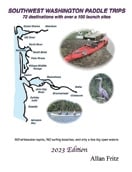
We stopped to stretch our legs a bit in Ilwaco, Washington, and popped into Time Enough Books. And just as I was heading for the door to leave, I found my answer! My gaze was snagged by a self-published book written by Alan Fritz, aptly titled “Southwest Washington Paddle Trips.” In fewer than 100 comb-bound pages (that look a little like they came out of a desktop printer that morning), this locally produced guide gives the reader the real inside scoop on where to launch their next flat-water adventure — from Ocean Shores all the way down to Nehalem Bay. Complete with simple, yet detailed maps and plenty of color photographs, the reader is told (and shown!) exactly what to expect at each site. I was thrilled to find this invaluable resource! The practical tips and real-world guidance of a local paddler already have me planning springtime escapes.
“The Antidote” by Karen Russell
 The final pick is a book that I, Barbara Engstrom, Chief Cook and Bottle Washer, recently read and enjoyed.
When I was reading Karen Russell’s debut novel, “Swamplandia!,” there was a point at which I had to put the book down for a bit because of the feeling of dread for what was to come. The tension of a 12-year-old’s perilous descent into the Everglades to search for her missing sister viscerally transported the reader into the morass. Karen Russell manages to pull off that same immersion in “The Antidote” — into the choking dustbowl of 1930s Western Nebraska. The Antidote is the name of a “prairie witch” who makes her living taking deposits of memories too painful to bear. She physically absorbs the deposits into her body — feeling the weight and burden of the memories but doesn’t know the details. Like a bank deposit, the memories are available for removal if her customer chooses. After almost being killed by the Black Sunday dust storm, The Antidote is horrified to wake up to a sense of weightlessness. The deposits are gone.
The Antidote’s story intertwines with the story of Del Oletsky, basketball loving, teenage girl whose mother was murdered; her uncle Harp Oletsky, a farmer reckoning with his family’s history as Polish immigrants and the repetition of centuries-old dynamics; Cleo Allfrey, a Black female WPA photographer avoiding sundown towns to capture the images of the Depression that her boss in D.C. wants featured, but with a camera intent on showing something entirely different; and the corrupt sheriff who claims to have solved the murders of several women by gaslighting the town into believing a homeless young man is the Lucky Rabbit’s Foot Killer.
So much of what Russell touches upon resonates today. The land grabs and social hierarchies that allow them, environmental degradation from destructive industrialized practices, the generational burden of debt, the memory holes that allow us to escape the weight of our own history, and governmental abuse of power to burnish one’s reputation while destroying communities. Ultimately, Russell leaves us with the sense that it is in the act of remembering that we can find hope and release.
Come Visit Us at KCLL
While we don’t have a fiction collection at KCLL, we do have a law book collection that we’ve lovingly curated and maintained. To find out more about our collection in print and eBook format, visit us at https://kcll.org.


