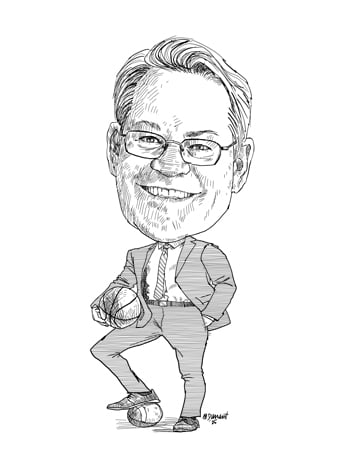
 Profile / David J. Seeley - From Courtrooms to Coral Reefs: The Remarkable Career of David J. Seeley
By Helen Boyer
David J. Seeley admits he never imagined having the life and legal career he’s had. How does a young man from Bellevue end up prosecuting a murderer with cutting-edge forensic techniques, being general counsel to Marlon Brando and Brando Enterprises, practicing international law, and helping to establish an environmental science research nonprofit based in French Polynesia, while maintaining an active public school law practice?
Lessons in Communication
David’s father was a model for him of working hard and playing hard. He was the first full-time orthopedic surgeon in Bellevue and was greatly in demand. He was also a pilot, scuba diver, mountain climber, hunter, fisherman, world traveler, and golfer. He volunteered as the team doctor for a local high school and was a philanthropist. David’s mother has always been outgoing and social, and she consistently treats others with appreciation, graciousness, and respect.
The family traveled internationally, so young David’s perspective broadened as he became comfortable interacting with people from many different backgrounds.
David was a middle child, with an older sister and a younger sister, with whom he is still close. He observed that members of his family tended to have very strong opinions on a variety of topics, which sometimes led to long debates on issues with entrenched positions. David chose a different way. He learned to persuade by listening, making others feel heard, and finding common ground.
After completing his BA in Finance at the University of Washington, David drove to Southern California, his car packed up with what he needed to succeed at the University of San Diego School of Law. When he arrived, he parked on Pacific Beach and went for a walk. That first night, his car was broken into, totally stripped, and badly damaged. Everything he owned was stolen.
Dejected, he thought, “Maybe I need to go back to Bellevue.”
“Fortunately, I stayed. I learned from that experience that when I am in a new place or situation, I need to ask local people for help and information.”
After passing the California bar exam, David and a friend from law school went on a South Pacific tour. After backpacking for two months, on his first night in Australia, David met his future wife, a Canadian who was working and traveling in Australia for a year. They stayed in touch, and she later joined him in the States. They’ve been married for 34 years.
A Young Deputy Prosecuting Attorney
David decided to return to Washington to practice. On his way from Seattle to an interview with the Clark County Prosecuting Attorney’s Office, he got a flat tire on I-5 just past Olympia. Dressed in his interview suit, on a very hot summer day, David changed the tire and still managed to get to his interview, only one minute late and with only a minimal amount of grease on his suit. They offered him the job.
He had played football and basketball in high school and enjoyed the structured competition of sports. He brought a competitive spirit into his practice as a trial lawyer and deputy prosecuting attorney. He wouldn’t fight just to fight. Rather, he evaluated whether a case was important and worthwhile to take to trial and then worked hard and did the best he could to prove all the elements of the crime charged beyond a reasonable doubt. “It was an amazing experience to become a member of the criminal justice community and to help victims of crime.”
He loved practicing criminal law and was with Clark County for 10 years. He took over 150 cases to trial. One of David’s murder trials was featured in an episode of “Forensic Files,” which still airs.1
David tells a story of getting really upset after a trial he didn’t win. “It was a difficult child sexual abuse case, but I believed the victim and went to trial. When the not guilty verdict came back, I couldn’t believe the jury did not find the defendant guilty based upon the evidence presented.
“One of the senior deputy prosecutors in the office saw how upset I was and said to me, ‘David, if you got all your evidence in, and you did the best you could do, you have to let it go. It’s out of your hands. Don’t make it personal. The jury is going to do what they do.’ That perspective was extremely enlightening and definitely helped me keep my job in perspective.”
Eventually, David began to see that he was becoming a bit jaded from being immersed in criminal law. It hit home that he needed a change during a visit to Saskatoon, Saskatchewan, where his in-laws lived. David and his wife were taking care of their high school-aged nieces and nephews, who were going out for a Friday evening with friends. As the teens got ready to go, David found himself grilling them about their evening plans.
“I totally read them the Riot Act. After they left my wife turned to me and said, ‘You need to calm down. These are good kids from a good family. We’re in Canada. We’re in Saskatoon. You need to relax.’”
David knew she was right, and that it was time to change legal careers and resign from the Clark County Prosecutor’s Office.
He was also interested in the challenge of learning new things and wanted to move back to King County.
In 2000, he accepted a position at the Kirkland firm of Livengood, Fitzgerald & Alskog.2 He did some criminal defense work for clients of the firm.
The shift to civil practice was challenging. “I was worried about the civil rules and discovery. It was all brand new, a little bit daunting and scary. I didn’t know anything about billing hours or obtaining clients. You end up taking clients that you shouldn’t take, because you want to fill your plate. It was a difficult transition.”
The Brando Connection
A couple of months into his civil practice, he got a call from the mother of a young man he had successfully prosecuted in Clark County. David had met her twice before, when her son had been arraigned on felony charges.
The first time they met, after her son appeared on the morning arraignment docket he handled, she came to the prosecutor’s office, wanting to talk to him about her son’s case. He referred her to defense counsel, but she persisted. Remembering his mother’s example of treating everyone with kindness and respect, David listened to her concerns and was honest with her about the risks of prison that her son faced.
“She told me that Marlon Brando was going to call me about her son. I had no reason to believe that she or her son was in any way connected to famous actor Marlon Brando. She was from a small town in the area. But I said to her that I would be happy to speak with Marlon. Of course, Marlon never called me.”
The young man eventually pled guilty and went to prison. Four years later, after he was released, he was re-arrested on a new criminal charge. His mother came a second time to the office, asked to talk to David, and told him that Marlon Brando wanted to talk to him about her son. David relates that he “was nice to her, and of course Marlon never called.
“Now she was calling me at my new civil practice. She asked, ‘David, would you like to come to work for me and Marlon?’ I thought it was my friends playing a joke on me, but I replied respectfully that of course, I would love to work with her and Marlon. In the back of my mind, I’m thinking, I have no civil experience, no Hollywood experience. Marlon Brando was one of the top 10 actors in the world at the time. She gave me a phone number and told me to call the next day to talk to Marlon, and that if we got along, they would fly me down to Los Angeles to meet him. I said, ‘Oh, perfect! That’s great! I’m happy to do it.’
“The next day I asked my paralegal to place the call and say, ‘David Seeley’s office, ready for Mr. Brando.’ I was sure it was a joke. But when she transferred the call to me, I knew right away that it was the real Marlon Brando on the line.
“He said, ‘David, I heard that you were really respectful to my business manager, and I followed your career. I would like you to come down and meet me.’ The next day I flew to Los Angeles and was picked up in a limo and taken to his home on Mulholland Drive. At the end of the day, he said, ‘I’d like you to come work for me.’
“I was honest with Marlon, and responded that I was new to civil law, I had never written a contract, negotiated any deals, and didn’t know anything about movie deal points, royalties, or trademarks.
“Marlon replied, ‘If you can’t figure it out, you can hire someone else, and you can manage them.’ And I said, ‘I can do that.’”
That began David’s 25-year-plus relationship as general counsel to Marlon Brando and, after Brando’s death in 2004, to Brando Enterprises.3
His courtesy and kindness to the mother of a criminal defendant had borne fruit. It turned out that the woman was a longtime family friend of Brando’s from Los Angeles, who worked remotely from Southwest Washington as Brando’s business manager.
An International Law and Nonprofit Adventure
In 1968, Brando purchased an atoll in French Polynesia called Tetiaroa. Brando had seen the atoll while filming “Mutiny on the Bounty.” He had a vision to build a small luxury sustainable hotel and that the atoll should be used for scientific research and education. He first sent David there in 2001.
David has since made more than 40 trips to French Polynesia and Tetiaroa. During many of those trips David worked closely with local French Polynesian lawyers, businesspeople, accountants, statutory auditors, scientists, local Brando family members, and government officials to help protect Marlon’s interest in French Polynesia. This eventually led to the development of The Brando, a small luxury hotel, on Tetiaroa. The Brando opened in 2014 and has been incredibly successful.
In 2010, David helped to found Tetiaroa Society, a U.S. nonprofit, with a field research station and education center on Tetiaroa that attracts international scientists focused on projects involving atolls, conservation, and education. Tetiaroa Society was created in line with the original vision of Marlon Brando. Research projects have addressed many topics, including coral reefs, sharks, seabirds, ocean acidification, archaeology of the atoll, invasive species, and microplastics.4 Tetiaroa Society and a community of donors, including David’s parents, other family members, and friends, have funded multiple University of Washington research projects on Tetiaroa over the last 11 years.5
David has traveled with family to Tetiaroa on multiple occasions. “Our family’s support of UW’s College of the Environment science projects on Tetiaroa has been a great way for all of us to stay connected over the things we care most about.”6 Many local high school groups have visited the atoll, including a group from the International Community School in Lake Washington School District and Lakeside High School.
David continues to serve on the Board of Directors for Tetiaroa Society. “Tetiaroa Society is innovative and unique.7 It has been an opportunity to give back to the University of Washington (11 of 15 family members have graduated from UW) and the world. I became a lawyer to help people. I’ve met a lot of amazing people, and I’ve had the opportunity to help the environment and protect Tetiaroa. The scientists and others that I’ve met are so passionate. They have been incredibly inspirational.”
A Philosophy of Respect in Practice
David’s practice for the last 25 years has also included representing several public school districts in Washington state. “In many ways school law is like being a prosecutor in that you never know what is coming. Many school law issues follow changing trends in society, so new issues are always arising. It’s a broad and diverse field, which I like. I’ve met some amazing educators and administrators over the years. It’s exciting to go to work and help solve problems with educators, students, and parents.”
In his work as a deputy prosecuting attorney and as general counsel for Brando, the lesson David learned as a young person — not to hesitate to ask for information — was useful. He needed to employ and consult specialists on a variety of topics. “I know what is in my wheelhouse, and I’m not afraid to say when I know I’m not the right person and I need to find someone else to help. It became important to network with a lot of different lawyers and experts. I have a good basis of referrals. If you treat other lawyers with respect and dignity, even when you are opposing them on a matter, you will be able to call that lawyer down the road when you need their expertise.
“I try to be a calming influence on people in crisis. If something crazy happens, I want people to be able to say ‘call Seeley.’’’
Advice to New Lawyers
Both of David’s children became attorneys. His children saw in him that lawyering can be hard work and an exciting, rewarding career. His daughter is a deputy prosecuting attorney in the King County Prosecutor’s Office, and his son works in construction law for a San Diego firm. However, since 2024 his son has worked remotely to help open the firm’s new Northwest office and has an office in David’s firm in Bellevue.
He would remind new lawyers not to take things personally. “Just do the best you can to solve problems and help people make good decisions.
“Practicing law is a business. You need to be a good businessperson. Good customer service is critical. That means making your clients feel heard, being available and responsive, giving them good advice, and providing documents in a timely manner.
“You also need to know how to assess a matter and select clients that are going to be a good fit for you and for your practice. You need to be able to advise when costly litigation is not a realistic solution. Clients for whom you’ve done good work are likely to be the best source for new client referrals.
“And always be gracious and treat people with respect and dignity.”
No Acting Career (Yet)
David tells a story about a documentary film project originally entitled “Lying for a Living, Born to Pretend,” in which he acted in a scene with Brando. Unfortunately, the project was never finalized and distributed. “That would have been my big break!” he says, laughing.
That may have been the film industry’s loss, but it was a win for those of us fortunate enough to know an attorney who operates with respect and kindness to all, works hard, asks for help when he needs it, and is comfortable working with people of diverse backgrounds.
Those qualities connect the moments in a career that has pivoted across many areas in which David Seeley has been effective and brought value to others.
Helen Boyer counts herself fortunate to have become acquainted with David Seeley during the years she worked in the Bellevue School District Legal Department.
1 In State v. Dennis Keith Smith, the body was never recovered and the case rested on DNA evidence. David is featured in the Forensic Files episode, which can be viewed on YouTube, Netflix, Hulu and other streaming services. Missing in Time, Forensic Files (Season 6, Episode 1), https://youtube.com/watch?v=e8tAQt_tANU&list=PLC4mqmKvz1Ib
Gw_iy8xPISKy2BMsXeXHc&index=1.
2 The Livengood firm later merged with Peterson Russell Kelley and is now Peterson Russell Kelly Livengood.
3 See Eric Lacitis, Kirkland lawyer guards the brand of Marlon Brando, The Seattle Times (Dec. 28, 2013, updated Jan. 4, 2014), https://seattletimes.com/seattle-news/kirkland-lawyer-guards-the-brand-of-marlon-brando.
4 See Tetiaroa Society website at https://tetiaroa
society.org.
5 See Michelle Ma, “A haven for research in the South Pacific, Tetiaroa offers new insights on tropical ecosystems,” UW College of the Environment News (May 22, 2024), https://environment.uw.edu/news/2024/05/a-haven-for-research-in-the-south-pacific-tetiaroa-sparkles-in-the-tropical-sun.
6 Meg Mathews, Seeley clan is a family of philanthropy, University of Washington Magazine (undated), https://magazine.washington.edu/feature/seeley-clan-is-a-family-of-philanthropy.
7 See Tetiaroa Society website at https://tetiaroa
society.org/david-seeley.


