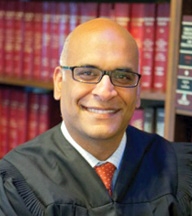
 By Judge Ketu Shah
A timeline can paradoxically seem both short and distant. How we perceive time and how that perception affects our work has a deep impact on the Court and the litigants.
Often when a case is filed, a case schedule is issued with a trial date in the distant future. We then think we have plenty of time to deal with this case. But with the blink of an eye, the deadlines are upon us for discovery cutoff, disclosure of witnesses, and suddenly the trial court calls to set up a status conference to see if the case is really going to trial on the scheduled date. We see this in our cases from civil to criminal to family law. Criminal law practitioners may have many pieces of evidence to review and may need to interview witnesses and arrange for experts to create reports to challenge the evidence. Family law cases have an emergent need to get temporary orders (time is very short), and then the trial can be a year later, and so time seems very distant.
Often, our Court hears complaints about cases taking too long to get a hearing or too long to get to trial. Recently, I was speaking to some veteran attorneys, and they recalled a time when there were no case schedules issued at the time of filing. This system led to inevitable continuances because it was left to the parties to determine when they were ready for trial. If they were not aligned, often cases were continued with no firm trial date. Civil cases took four to five years to get to trial and there was a huge backlog of cases.
A joint taskforce of the Court, the Bar, and other stakeholders led reforms in the early ’90s that resulted in every filed case receiving a case schedule with a trial date. Cases were assigned to individual judges from the beginning and deadlines were set. The attorneys I was speaking with appreciated these reforms for the simple reason that they worked better with deadlines. That is to say, when time was short, they were more efficient, and when time was distant, they were very inefficient.
As cases ebb and flow, there are times when certain types of cases surge into the court, creating backlogs, and then we analyze the data and adapt our resources to deal with those cases. In the ’80s and ’90s there was a surge of asbestos cases that required special procedures to handle these complex cases. Recently, coming out of the pandemic, we had a backlog of criminal cases and needed to apply extra trial court resources.
Now, we are seeing a surge of unlawful detainers and civil protection orders that has demanded additional resources that the Executive and County Council agreed to provide. We hear feedback that obtaining a hearing date on the family motions calendar is a long and arduous process because our commissioners are brimming at capacity dealing with civil protection orders.
We also hear from trial attorneys who worry about whether their trials will get to a courtroom on the trial date given our brokerage system that relies on reviewing all parties and court availability, balancing criminal and family law priorities, and then finding a courtroom that fits everyone’s schedule. The wait to be assigned to a courtroom can feel interminably long and uncertain. Time can feel very distant in those moments.
We heard from a broad array of voices that unlawful detainers were taking nine months to get to a hearing, and thus with additional judicial appointments, we have reduced that to about two months to obtain a hearing.
As an institution, we want to ensure cases are processed efficiently and timely. We understand that people’s perceptions of the court — and whether the rule of law works — are based on whether they can have their voices heard in a timely way. If we cannot meet that expectation, people’s perception of the courts is tarnished.
I write all this to say the Court understands these tensions. When we grant or deny a continuance, all of these competing interests are in our minds. We want to be efficient but also give practitioners an opportunity to be prepared and marshal their resources to present a case for the best interests of their client. We want the public to have confidence in a system that values all voices. We want to be good stewards of public dollars and apply our limited judicial resources to maximize effectiveness.
Internally, we have discussions and training on how to evaluate continuance requests. We are mindful that if continuances are repeatedly granted, then one party is impacted more than the other and time seems very distant to them. And yet, if we do not grant a continuance, time is very short to be prepared and for the practitioner to be effective.
And, in many ways, each of us needs to live our lives with a similar mindset. What seems distant is really just around the corner. I have all these places to travel to, but where do I find the time? I have a stack of books I would like to read but am too busy watching the latest soccer match. Time is both distant and short. I hope to remember that professionally and personally.
As always, we welcome feedback and conversation on how our court can serve the King County Bar and the members of our community. Please reach out to further that conversation.


