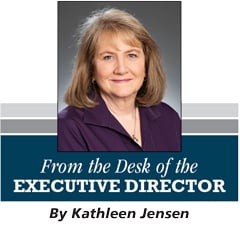
 As an association executive, I spend a lot of early mornings before my workday starts catching up on articles about association membership and what associations need to prioritize in 2025. Recommendations include enhancing member value, increasing member engagement, adapting to members’ changing needs, embracing and leveraging technology, diversifying revenue streams, and staying ahead of industry shifts.
As I read these articles, I get a feeling of déjà vu. Since these priorities do not seem all that new to me, I decided to see what the industry’s priorities were in the early ’90s when I started in association management. A quick internet prompt discovered that organizations faced a challenging landscape in the early ’90s and were navigating a period of transformation. The organizations that prioritized members’ changing needs, the rapid growth of technology (at that time, the development of the internet!), and broadening the available engagement opportunities were better positioned for long-term success. Sound familiar?
While in the ’90s we might have provided CLEs about using the internet, now we offer CLEs on AI and the ethical use of it in the law. Similarly, from an aerial view, the same things are important today, but modernized; to serve our members, we must adapt to new ways that members want to engage with the King County Bar.
Gone are the days when all the section meetings and KCBA CLEs were held in person. Now, our sections provide either fully online or hybrid format meetings. Even when we decide to host in-person-only events, these usually come along with requests to make them hybrid for accessibility or convenience. As staff, we find that we have fewer opportunities to interact in person with our members since they are no longer visiting the office for events or meetings.
So, what does this mean for KCBA? It means we need to adapt to meet our members where they are. According to the Center for Association Leadership, “purpose-driven communities are core to growth, innovation, and sustainability. Associations that evolve from being service providers to becoming community platforms — where members actively co-create value — gain significant competitive advantages.”1 With a significant portion of our members still working remotely, we need to make sure our offerings still build a community for the members — one that is organized around a shared purpose, commonalities, and mutual value.
One area of the Bar that truly embraces this community view is the New Lawyers Division. NLD is one of the most active communities of the Bar and encompasses over one-third of the Bar’s membership. Many members are unaware that membership in NLD is automatic; if you join KCBA and are within your first 10 years of practice, you are an NLD member without taking any additional action. Just by joining KCBA, our membership database recognizes your years of practice and, if applicable, includes you in any events, CLEs, volunteer opportunities, and other communications about the offerings of NLD.
And this community is one we’ve cultivated for a while. Surprisingly, many of the articles I read recommend to associations that they develop a community for their newest professionals. KCBA, by contrast, has been doing this for a very long time. In 1949, recent law graduates, who quickly realized that they were long on book-knowledge but short on practical knowledge, decided to form a Young Lawyers Committee in the bar association to help share the nuts and bolts of law practice. In 1976 the YLS (they had changed from a committee to a section) published the first version of the Washington Lawyers Practice Manual from materials developed for its “Bridging the Gap” Seminars. The publication won an ABA Achievement Award for the single most outstanding project in the country.
The KCBA new lawyers’ group has long been successful. In 1988, the YLS Board made it a goal to open four more legal clinics. In 2011, YLD (now a division of our Bar) led KCBA’s support for eliminating life without possibility of release or parole sentences for juveniles. In 2022, YLD changed its name to the New Lawyers Division and updated its eligibility requirements to build a more inclusive community.
If you are looking to connect with like-minded individuals and are within your first 10 years of practice, I encourage you to get involved in NLD. It is a long-standing community with a shared purpose and identity that can really create an impact on the Bar’s future just as they have done for the Bar’s past. If you are beyond your first 10 years of practice, do not fret! KCBA has committee spaces that need your expertise and are, themselves, communities. With your involvement, these communities thrive and become the fabric of each committee member’s professional life. And as KCBA settles into this “new normal” of mostly hybrid community, we continue to innovate additional offerings to ensure our members always have ways to connect.
Kathleen Jensen is KCBA’s executive director, and she can be reached by email at kathleenj@kcba.org or phone at 206-267-7053.
1 asaecenter.org/resources/articles/an_plus/2025/
06-june/building-community-your-associations-
strategic-advantage


