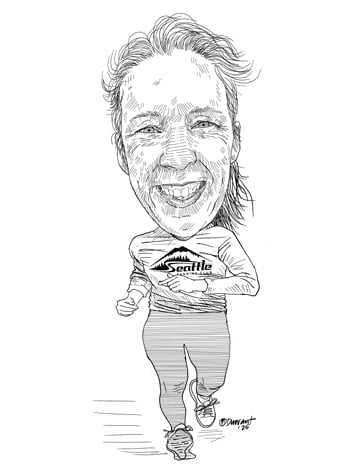
 Profile / Natalie Roberts: Charting a Course at the Pinnacle of Family Law
By Lee Nacozy, Bar Bulletin Editor
Natalie Roberts is a dedicated family-law attorney who will become a partner at Wechsler Becker at the start of next year. With over 15 years of experience, she has built a reputation for her strategic litigation skills and compassionate client advocacy. For the past year, she has served as the chair of KCBA’s family-law section.
Natalie vividly recalls a formative moment from when she was an undergraduate and student-athlete at the University of Tulsa, contemplating her future. An attorney happened to be auditing a class she was in, and she told him she was considering applying to law school.
“He asked me, ‘Would you like to be in an intellectually stimulating environment with people who are interesting and fun to be around?’ I said, ‘Yes, that sounds good!’ And he said, ‘Then, law is something that you should pursue.’”
Natalie was earning a Bachelor of Arts in English Literature, and would graduate cum laude, but felt a career in that direction would limit her.
That passing exchange she had with a lawyer left a lasting impression. “It gave me confidence that it would be something that was interesting to me.”
After college, she attended Seattle University School of Law and graduated cum laude from there in 2009.
She then began practicing family law by chance. This area seemed intimidating at first, but she quickly felt in sync with it. “I took ‘family law’ in law school, but law school is so different — you know, it’s not really focused on the practice of law. So, I fell into family law and liked it because it is litigation heavy.
“I liked that courtroom experience. There’s a heavy motions practice in family law, where you’re in court on pretrial motions for temporary orders a fair amount. It’s exciting to me.”
Though she thrives on the courtroom dynamics, Natalie’s success is equally rooted in her balanced approach. She credits her undergrad years as a Division I track and cross-country athlete for teaching her the importance of civility, which she says is crucial to successfully practicing family law.
“Being an athlete, you really learn how to be a strong competitor while you’re competing, in my case, on the track or running cross country. If you’re on a field or on the court or whatever it is, you can be a very fierce competitor. But then when you are not competing, you can be friends with your competition,” she explained.
“I’ve really tried to utilize that as an attorney, in being a strong advocate for my clients but also being able to be a colleague to the attorneys who are on the other side of cases. I think it’s actually an area that could be improved upon in family law. There are too many attorneys who only know the fierce competitive side, and they don’t look at opposing counsel as a colleague. I think that’s really important.”
This mindset has also shaped her approach to community and leadership. “If you think about the best athletes we all know and admire, they are people who tend to be friendly people who are leaders in the community, off the athletic field. They’re not people who are angry and competitive constantly.”
Natalie’s dedication to balance extends beyond the courtroom. Running remains a key part of her life and a tool for maintaining equilibrium.
“Running is really important to me. It helps me maintain work-life balance,” she said. “I run with a running group, Seattle Running Club. Having that team and our scheduled runs and workouts gives me accountability as well as a group of friends that I mostly see running and want to see.”
This also structures her time. “It helps me schedule my work around having to take this break to go running or to do this weekend event or something like that. Even if I don’t have a team workout, I know that I need to keep up with my individual runs so I can run with the team.”
Running also gives her mental space. “When I’m running, if I’m not doing a really hard workout where all I can think about is how painful it is, I’ll often think through cases. So even though it’s not work at all, but it does help me think through things.”
Even as a lifelong runner, she relates to the resistance many people feel when working out seems too hard or it’s dark, cold, or raining.
“I feel so much better when I get outside and get fresh air. I mean, there’s a saying that the most difficult part of a run is the first step out the door. It’s not easy to go running when it’s 4:30 [after a day of work] and pouring down rain and dark and freezing cold.
“It’s hard for me to run. It’s not easy to get out there, but I almost always feel better when I do. Sometimes I will go back and work for a couple hours on the backside of it but have had that little break. Or sometimes it’s the way that I end my day. It really does help a lot.”
Natalie’s second piece of advice for balance is to populate your calendar with nonwork commitments. Then you will actually make time for these things and have them to look forward to.
“Just having something on the calendar, having the Seattle Running Club and the group runs on the calendar, helps. Same with my family — having a date with my husband or a family outing on the calendar. Then everybody’s expecting me to show up. We are all planning on it.
“Same with vacations. I know it gets easy to just put off planning a vacation, but getting it on the calendar helps because before you know it, your calendar’s booked up for several months and then you can’t take a vacation for several months.”
As Natalie prepares to become a partner at her longtime and preeminent family-law firm, Wechsler Becker, she reflects with pride on the practice she has built. Family law, she says, turned out to be the right fit — and she encourages other lawyers not to shy away from it.
“My big advice for people aspiring to become attorneys who may not know what field they’re going into or are finding themselves in family law a bit: Don’t be afraid of family law.
“I think people are afraid of it for a variety of reasons. Yes, it’s complex. As a family-law attorney, you may deal with business-ownership issues, complex estates, domestic violence. People might be afraid of family law because it has all those intersections with other areas of law, but you will learn or can bring in colleagues or specialists.”
In conclusion, she said, “The rewards are there because you really are impacting somebody’s life in a very direct way.
“For most people, their family is the most important thing. So, helping people navigate a divorce or a change in their family structure can be really rewarding.”


