 Washington’s Historic County Courthouses
We received a wonderful book donation to the law library the other day. Washington’s Historical Courthouses is a fascinating pictorial journey into Washington’s legal history through the lens of the state’s county courthouses. Author Ray Graves practiced law for over 50 years, primarily in Tacoma. But during his long career, he had occasion to appear in nearly half of Washington’s 39 county courthouses.
When visiting and working in these courthouses, Ray was struck by the architectural and historical significance of these buildings. Particularly when the grand old structures were destroyed and replaced. Ray recounts that courthouses in Pierce, Yakima, Whitman, Whatcom, and Kittitas counties were torn down and replaced during the course of his career.
Ray took it upon himself to memorialize this architectural history by photographing and researching county courthouses that were built in 1930 or before and still in use in 2002 at the time of publication of the book. For buildings that had been razed, he included pictures of the building that was standing in 1930 and often earlier buildings as well.
County Seat Shenanigans
While this book is primarily pictorial, Ray did quite a bit of background research and sprinkled it with interesting stories. His research led him to the wiliness of the decision-making process for establishing county seats in the frontier days. “The ultimate decisions were made, in most cases, by a vote of the county’s citizens or by the legislature and, in one instance, by the U.S. Congress.”1
Being the county seat was sure to be an economic boost for a municipality, so the competition was often fierce. Ray gives accounts of “rowdies” and “kidnappers” removing county records from previous county seats to the new seats by the barrel of a gun.
Perhaps the most notorious contest took place in Lincoln County in 1884. Sprague received the most votes, but the number of votes it received exceeded the total voting population of the county! Davenport claimed the names of the Sprague voters were taken from tombstones and train passengers going through the area. Although Davenport sought court relief, it also called for help from the nearby settlers, who came armed with Winchesters, shotguns, and six-shooter guns to keep the records in Davenport, they were confronted by one A.W. Hutchinson, who, with his long-barreled revolver, offered to shoot it out with the sheriff, with the county seat going to the town of the survivor! Fortunately, cooler heads prevailed, and the records were finally surrendered to Sprague.2
Stroll through a Few of Washington’s County Courthouses
Below are some highlights and fun facts about a few of the courthouses featured in the book.
Asotin County
The original wood-constructed courthouse was built in 1899 but was destroyed by fire in 1936. The county bought the Ayers hotel out of foreclosure and repurposed it as the courthouse. The hotel was rumored to have housed a brothel in its storied past. It continues to be used as a courthouse and is the only county courthouse that was not purpose-built as such.
Clallam County
Built in 1915, a significant feature of the Clallam County Courthouse is the four-sided clock tower with a bell perched on top.
The clock itself has an interesting history. It was manufactured by the E. Howard Tower Clock Co. of Boston, Massachusetts, in 1880. … The clock, along with the bell, was shipped around Cape Horn in South America to Seattle in 1885, but the purchaser never claimed them. They sat on the dock until [Clallam courthouse] architect Grant discovered and purchased them for the courthouse, where they were installed at a cost of $5,115.3
The inside of the courthouse is a stately marble interior. The “marble” however, is scagliola, “made from cement, plaster of paris, powdered alum, water, and fine sawdust tinted ochre, umber, or dark green with horse hair stretched out in the wet scagliola and left to dry.”4
Franklin County
The signature feature is a large dome ornamented with art glass naming each of the towns of the county in existence during construction in 1912. In 1974 a mail bomb caused damage when it exploded in the chambers of Judge James Lawless.
Garfield County
This courthouse features a roof-top statue of lady justice perched above a dormer clock. A restoration of the interior included refurbishing the oak seats with wire hat racks tucked beneath. A friend who grew up in Pomeroy recalled the courthouse from her youth. “When they weren’t holding trials or other official business, we had 4-H exhibits in one of the courtrooms. Sewing and cooking, not critters.”
Grant County
The building was constructed so that portions of the building used a geothermal heating system, taking advantage of a nearby hot spring.
Grays Harbor County
Of great interest are the two murals in the main hall opposite each other as well as those in the courtroom. The murals were done by two well-known artists. One mural in the hall depicting Captain Robert Gray’s landing in 1792 was done on canvas by Franz Biberstein, a Swiss-born artist from Milwaukee, Wisconsin. The opposite mural was done by Franz Rohbeck, a German born artist. … Rorheck’s mural depicts a historic treaty with Native Americans concluded at Cosmopolis, Washington in 1855. … It is interesting to observe that the dress of the Native Americans in both murals is not the dress of the area, but rather of Plains tribes.5
King County
The original King County courthouse was built in 1882. A striking feature was an unwieldy looking cupola at the top. With several architectural styles among the many additions, it was known as the “Katzenjammer Castle.” It was sold to Seattle in 1891 to be used as city hall. The present courthouse was completed in 1916 as a county-city building, with five stories added in the 1920s. King County became the sole occupant of the courthouse in the early 1960s.
Pacific County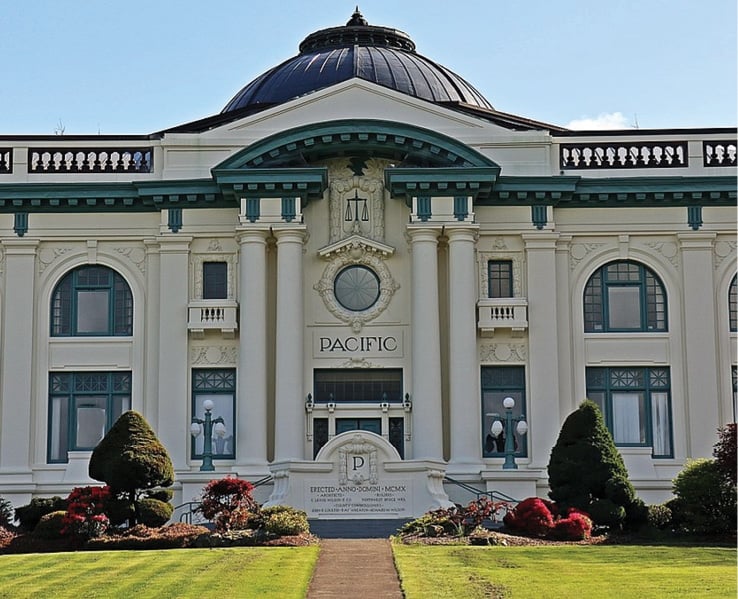
Completed in 1910, during its early years this courthouse was considered pretentious and referred to as the “Gilded Palace of Extravagance.” For good reason. It is a stunning building with a beautiful art glass dome and art glass dome lights in the courtroom, along with intricate molding framing inset panel paintings.
Pierce County
The original building looked like a Hogwarts set piece, much in keeping with the grand style of Tacoma’s Stadium High School. Unfortunately, it was severely damaged in an earthquake in 1949 and torn down.
Snohomish County
After the previous courthouse was destroyed in 1909 by an act of arson, a new courthouse was erected in 1911 in the Mission style. It was the first building in the Mission style west of the Cascades, “in a climate seemingly unsuited for the style.”6
Spokane County
Ray devotes several pages to the Spokane County courthouse, clearly a favorite of his. The design was based on two French chateaus in the Loire Valley. Befitting construction of a courthouse, a legal dispute delayed completion until the architect was ultimately cleared of wrongdoing by a grand jury. Courthouse employees were also found to be living and cooking in the building soon after it opened.
Stevens County
In a spirit of civic-mindedness almost impossible to imagine today, construction of the original courthouse in 1898 was initially funded and undertaken by a group of citizens. Prior to completion, the government took over responsibility for the project. It remained in use until 1938.
Take a Look for Yourself
If you would like to see the historic county courthouses for yourself and read about their history, come visit us at the law library. If you are interested in obtaining your own copy of Ray Graves’s Washington’s Historical Courthouses, contact us at services@kcll.org.
1 Ray Graves, Washington’s Historical Courthouses (Elfin Cove Press 2002) pg. 8.
2 Id. at 9.
3 Id. at 22.
4 Id. at 25.
5 Id. at 48-49.
6 Id. at 89.


