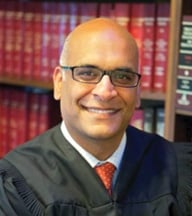
By Judge Ketu Shah
I often get questions from folks who are thinking of a judicial career about what actions they can take to position themselves to be an excellent judicial candidate. Often, I speak about getting trial experience to show your proficiency in managing a courtroom, be professional and respectful to everyone especially opposing counsel and staff because that will reflect on your demeanor. Be engaged in your personal and legal community because it shows your commitment to public service. And of course, work hard, meet deadlines, be prepared, and demonstrate your intellectual analytic ability in your written and oral presentations. For many people, these are some obvious points of advice. Often people have practices where they do not get the opportunity to be in court, so I recommend they volunteer as Guardian Ad Litems (a huge need in minor dependencies and for vulnerable adults) or volunteer with the Court looking for attorneys to assist those litigants who have an ADA accommodation. Also, there are great legal clinics (KCBA Neighborhood clinic, ELAP clinic, NWIRP clinic, and many others) where you can get cases to help folks and get real world courtroom experience.
There are also tradeoffs when you become a judge. You lose the flexibility of schedule that you may have had in practice. As a judge, everyone is waiting for you to begin, so you must be available for court from 8:30 to 4:30 every day. Running to do a quick errand is not possible except for lunch. But at lunch we often have meetings to conduct the work of the Court. And therein lies one of the big misconceptions of being a judicial officer. Many attorneys see us in court on the bench and observe the work we do when we are in open court. What many do not see is all the work and meetings conducted when we are off the bench that make our court and rule of law work.
We often have meetings about our budget, about local rules, about policies we want to deploy regarding access, technology, and court records. We meet to discuss procedural issues we are seeing or capacity issues when there are spikes in filings like unlawful detainers and civil protection orders. We meet to adjust our workflows so that we are as efficient as possible. We meet with state colleagues to discuss potential legislation, court funding, and court education. Often, these meetings are at lunch or at 4 p.m., sometimes even on Saturdays. The Washington Pattern Instructions Committee has met on Saturdays for years. We have judges volunteering their lunch time to sit on budget meetings, planning for education events, and local rules. We have judges and staff meeting on calendar capacity for civil protection orders, family motions calendars, ex parte calendars, and unlawful detainer calendars.
That is to say, the rule of law requires the Court to have policies and operations that serve the litigants so that they can reasonably access our courts. Our judges and staff attend these meetings tirelessly, trying to improve our court. Folks like Judge Thorp who works on ensuring our technology and local rules work for our litigants and cleans up our General Orders so that they are easily found in our court records. Folks like Judge Sutton who meets with bar members, commissioners, advocates, judges, and staff to try to increase our capacity for civil protection orders and family law motions so there are not lengthy delays. Folks like Judge Scott who meet late into the evening with tenants and landlord attorneys to streamline our unlawful detainer process by organizing calendars in a way to get maximum participation. Folks like Judge Galvan and Judge McCullough who meet with community groups to figure out new ways to support our youth so they can get positive guidance and structure to reduce recidivism. Folks like Judges Young and Keenan who meet with prosecutors and defense attorneys to talk about local criminal procedures so that criminal cases can more expeditiously reach a conclusion. Judge Ballinger meets with judges across the State to determine as a body what positions we should take on legislation. Judges Larranaga and Robertson work on how we can understand and increase jury diversity by the way we summons and continue to utilize remote voir dire. Judge Rothrock organizes and creates education programs for our judges to help them learn and be better on the bench. Judge McCoy works on creating new procedures for minor guardianships in our Dependency department. And Judge McDonald who co-chairs the WPIC committee that meets on Saturdays to help craft model jury instructions that are the life blood of trial courts. There are many more judges who do this work every day of the week during lunch and after hours. This work is unseen but is critical for the functioning of our court and the rule of law.
Resolving these operational issues is necessary for a court of our size and complexity to function. Your judges on King County Superior Court take these actions behind the scenes every day to serve the public. When we discuss the importance of the courts being a place where civil society can come to resolve their disputes, we are really talking about all the time and energy our judges expend off the bench to create rules, procedures, and policies to make the court operational.
When someone is thinking about being a judge, they should also be thinking about how I can make the court more efficient and accessible. Are there avenues in your career that you have helped a nonprofit operate, or assisted in firm operations, or provided guidance to your employer to navigate personnel issues? These are all tasks that fall onto a judge and those that are most prepared for a judicial career have given some thought or have experience in these areas.
As always, we welcome feedback and conversation on how our court can serve the King County Bar and the members of our community. Please reach out to further that conversation.


