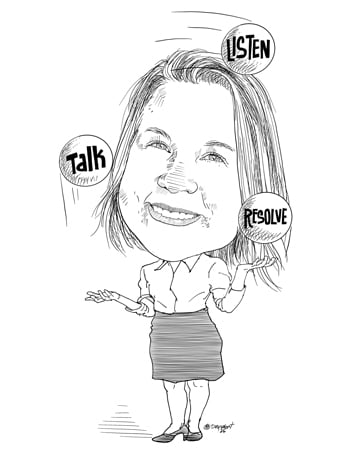
 Profile / Paula Emery: Client-Centered and Future-Focused
By Schuyler Peters
There may not be anyone who embraces change as wholeheartedly as Paula Emery. As an experienced attorney, mediator, leader, and educator, Paula has created an interdisciplinary practice at the forefront of her field. While Paula serves today as the Chair of the WSBA and interim Chair of the KCBA’s Dispute Resolution sections, her path to a career in mediation does not appear, at first glance, to have been linear. However, in many ways, this could not be further from the truth. Both inside and outside of the profession, Paula’s career speaks for itself—her deep commitment to justice and conflict resolution began long before she first took her Oath of Attorney. In fact, Paula embodies the true definition of someone who has always known their calling, and who has done everything in her power to find ways to best serve her clients.
Paula first set her sights on law school at around twelve years old. In recalling this chapter in her life, Paula stated that she always felt drawn to debate, argumentation, and complex issues.” Growing up in a small town in Nebraska, Paula’s parents were surprised by her goals, but she was steadfast in her belief that she belonged in the legal profession.
As a first-generation college student, Paula attended the University of Nebraska at Omaha. Like many eighteen-year-old students entering higher education, Paula remembered having little understanding of what she was getting into, but she remained focused on her interests, majoring in both Political Science and Communications. Determined to make the most of her time after graduation, Paula leaned on a classic decision-making tool when choosing between heading to law school and joining the Peace Corps: she flipped a coin. When law school won out in the coin toss, Paula dutifully studied for the LSAT.
After earning a competitive score, Paula moved from Omaha to Lexington, Virginia, to attend Washington and Lee University School of Law. While she now emphasizes the critical importance of trying to attend law school in the city you hope to practice in, Paula learned considerably from her time at Washington and Lee. For two years, Paula took part in—and eventually led—a capital punishment clinic. This work, she says, “lit a spark,” that further cemented her passion for the practice of law.
Near the end of her third year, Paula realized that she did not want to remain in Virginia, nor return to Nebraska. Over spring break, a few of her friends took a road trip to Austin, Texas, and shared with Paula that they loved their visit. In fact, they hoped that she would join them and move to Austin after graduation. With only five days to turn around an application to the Texas Bar, Paula was not sure it would be feasible—she did not have enough money in her checking account at the time to cover the application fee. In a moment Paula will never forget, a lucky turn of events occurred: her mom happened to send her a check in the mail for “an odd amount” that happened to almost exactly cover the cost of her application. After a summer of long hours studying, Paula passed the Texas Bar Exam.
On the day Paula was sworn in, she received word about a list of attorneys who had been appointed as defense counsel in post-conviction cases. While at the courthouse taking her Oath, Paula asked the clerk to see the list, so that she could reach out to help. As it happened, Paula’s first position as an attorney was on contract, helping attorneys represent individuals’ post-conviction. During this time in Paula’s career, her work ranged from capital crimes appeals and habeas corpus litigation to civil litigation matters, including creditors’ rights, debtor issues, employment concerns, and family law. It also marked Paula’s first professional experience as a mediator. Looking back on this “first act,” as she called it, Paula recalled, “a lot of highway time”—she learned early on how big Texas really is.
Paula believed she was destined for a career in criminal law. As she progressed, Paula took on more responsibility in the cases she was a part of—transitioning from assisting attorneys to working alongside them. In one particular example, Paula remembered being asked to help with a habeas petition to which another attorney had been appointed. To her surprise, rather than being delegated discrete assignments, Paula was invited to work in concert with another lawyer. This opportunity excited her, and she continued to take on more challenging cases. Paula explained that in Texas at this time, it was incredibly difficult to work on capital punishment cases. The outcomes were either bittersweet at best or crushing at worst. While she still cared deeply about the causes that she dedicated her early career to, Paula felt that it was time to switch gears.
In yet another moment of fortuitous timing, a book club friend of Paula’s reached out, recommending a position to Paula because her boss needed “someone smart who could write well.” This led Paula to become a Customer and Partner Relationships Manager at Tatum, LLC, in Austin, where she “rode the first full wave of the internet.” Paula jumped head-first into this position, embracing the challenges that clients presented. Although she was not practicing law, this was her “first taste” at a few important skills every lawyer aims to develop: navigating complex personalities, producing polished and well-developed work in a short time frame, and communicating expectations to both clients and partners. Paula realized that law school was helpful in teaching her to think like a lawyer, but it did not provide the experience of “drawing information from a client in a way that encouraged trust and further disclosure.” Today, these are the same skills that Paula impresses upon her students in the classroom.
The ripple effects of the country’s struggling economy made their way to Paula’s employer. After working for six new managers in only seven weeks, she saw the writing on the wall. True to her proactive attitude, Paula had already reactivated her law license and changed her phone voicemail before she had been officially laid off. Back to practicing law, Paula’s first clients were former coworkers who needed assistance understanding their NDAs, and young professionals who had not set themselves up for an economic decline. This was the closest, Paula recounted, to being a generalist in her career.
While transitioning back to a career in the law, Paula met Grant Emery, the man who would one day become her husband. After being laid off from his own tech position, Grant was heavily recruited by both Google and Amazon. Agreeing to move from Austin, Paula urged him to head to Seattle instead of California—she liked her odds better at passing the Washington Bar Exam. But due to her tech connections, Paula instead joined Microsoft in a technical product marketing role in the early days of cloud computing and big data. In many ways, this experience speaks to Paula’s interdisciplinary approach as a lawyer and mediator today. Her roles with customers and partners at Microsoft helped shape her view on what it means to be a client-centered lawyer: asking good questions, learning the strengths and weaknesses you bring to each conversation, and sensing a client’s most important priorities.
Paula’s growing family led her, once again, to consider her next steps. In evaluating her priorities, Paula decided it was time to leave the corporate world. While grateful for the time she spent with her two young children, Paula remembered this time as a period where she lost a lot of her professional identity. Even so, she continued to learn and engage with those around her, and she made keen observations in the process. Paula recognized the significant amount of unpaid labor and dedication that goes into almost every aspect of childhood education, and that, combined with the outcome of the 2015 presidential primary, ultimately led to Paula’s inevitable return to the law.
In 2017, Paula decided to sit for the Washington Bar Exam. As a first step, she took the MPRE at Seattle University, the law school Paula would serve as professor a few short years later. After passing the Bar, Paula took a 40-hour Basic Mediation Training offered through the Dispute Resolution Center of King County. Based on a facilitative model, Basic Mediation Training fit the client-centric beliefs that Paula stood for. Rather than treating mediation as another opportunity to litigate, Paula appreciated the chance to help parties take charge of their own solutions. As a proponent of a client-centered legal practice before it was popular, Paula saw a way in which she could valuably contribute to her community. As such, she started Emery Law and Mediation Services, and she continued to educate herself on the myriad ways in which dispute resolution techniques continue to evolve. In taking various courses at law schools across the country, Paula saw firsthand how negotiation, mediation, and client counseling skills could be used to promote party self-determination.
Paula’s passion for dispute resolution eventually prompted her to move into leadership with the WSBA and KCBA’s Dispute Resolution sections, eventually holding two Chair positions. Over the last several years, she has aimed to bridge the gap between experienced practitioners and new enthusiastic attorneys. In another moment of happenstance, an opportunity presented itself for Paula to help make this mission a reality. Paula’s Basic Mediation Training instructor, Dee Knapp, was the longtime Professor of Mediation at the Seattle University School of Law. When Dee decided to retire from teaching, she hoped that her replacement would care as deeply as she did about the facilitative model. Paula could not have been a better candidate.
As a Mediation Professor and Faculty Advisor for Seattle U’s Dispute Resolution Board, Paula has brought fresh energy into Seattle U, helping students to learn the applied skills that she wished her law school had exposed her to. While doctrinal courses have historically taken precedence over DR techniques, the “Next-Gen Bar Exam” has turned this reality on its head. In what Paula coined a both “delightful and apprehensive” period of transition, the skills she has dedicated her profession to—skills that have been often regarded as “extracurriculars” in the law school consciousness—now are seen to be increasingly vital to the success of law students.
Unsurprisingly, Paula’s own pursuit to learn also continues to evolve with the times. Rather than shying away from the introduction of Artificial Intelligence (“AI”) to the practice of law, she has been connecting some dots between her legal and technological career path, presenting on large language models, and the intersections between AI and attorneys’ ethical obligations. In her future work, Paula hopes to use her past education to enter the public policy and natural resources space as a means to help deeply invested disparate stakeholders tackle today’s environmental-related challenges. At her core, it is clear that Paula practices the tenets of a lifelong learner—addressing an issue from many angles, diversifying her skill set, and seeing challenges as new opportunities. While much can be gleaned from Paula’s career, one of her most admirable traits is her pursuit, in any situation she enters, to leave the world better than she found it.
Schuyler Peters is an attorney at Ryan, Swanson & Cleveland, PLLC, and she can be reached via email at peters@ryanlaw.com.


