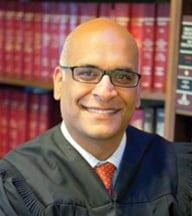
By Judge Ketu Shah
For those of you who swear, you understand. Sometimes you experience something that makes you swear. I have been known to swear on the pitch, in my car, or when I stub my toe on a chair. We have all been there. Once, as a young soccer player on my college team, recently being promoted to start, I missed a very simple backwards pass trap. The ball went under my foot as I looked away, my opponent quickly pounced on my mistake and took the ball the other way. #$%&* quickly rang out of my mouth near our bench. The coach immediately subbed me out (I am sure for my swearing because I had made other mistakes, and he did not sub me out) and I fumed on the sideline about my careless mistake. I used to swear when in law school in Minnesota when the wind chill was negative 50 degrees as I walked from my car to the law building. I was convinced my swearing would warm me up, but sadly, only my mouth heated up.
In our professional lives, our swearing is more calculated. At times, we swear at the office in a professional setting to make an emphatic point but not at home with our children present. Somehow the professional setting gives us license to be more candid. And this is not only true in the legal profession as I have spoken to many friends in many different professions where this rings true. Things are said at the workplace that would never be said at home. In our profession, swearing is commonplace when you are in the middle of a trial and things take an unexpected turn. Swearing is commonly an adjective describing opposing counsel or a judge. Many times, this verbal outlet is a release of frustration in a stressful situation. How many of us have said &*%$# opposing counsel, or &*%^$@ judge? And, at times, this venting occurs in more public settings such as on message boards, social media posts, and listservs. At times, the opinions of our profession and colleagues are vitriolic. It is painful, coarse, and sometimes racist or misogynistic. Many of us have been the recipient of these insults and have learned how to move past them because we are professionals and are not defined by other’s stereotypes of us. But nonetheless, they are painful. And more importantly, they demean our profession. Our bench will receive the KCBA judicial surveys this week and included in our confidential packet is anonymous feedback. You would be amazed at the language used to describe us. Comments from members of our bar would make your swearing look tame. It is unfortunate that some folks feel that anonymity gives them license to be disrespectful and spiteful.
Leaders from the Bar and Judges have been advocating for more civil discourse for generations. Confidence and trust in lawyers and judges is low. The Rule of Law is often attacked as being unfair or biased and the entire system should be thrown into a dustbin. None of this is new. What is different is how people express these opinions. The platforms are larger and more widespread. The message is carried wide and far. When we casually describe opposing counsel or the judge in an insulting way, we contribute to the disrespect this breeds, and it gets exponentially amplified.
As the KCBA recently noted, there has been an uptick in rhetoric about attorneys and judges. I bring these issues to light to remind us of the importance each of us plays in protecting the Rule of Law and the Courts. Even the words we use casually, can have a deep impact on how people view us. It is critical that we as a profession ensure that attorneys and judges are treated with respect and dignity. We may disagree, in fact, we may vehemently disagree. But we must encourage civil disagreement and allow the rule of law to work its will. We have neutral decision makers, we have juries, and we have reviewing courts. Attorneys and judges are not perfect, and we will make mistakes. But I am hopeful that each of us entered this profession to serve people and our clients. We can serve them best by instilling in them the confidence and trust that our legal system works for the good. We do not always get it right, but we try with good intentions and so the next time you want to swear about opposing counsel, or the judge, please remember others are listening.
As always, we welcome feedback and conversation on how our court can serve the King County Bar and the members of our community. Please reach out to further that conversation.


