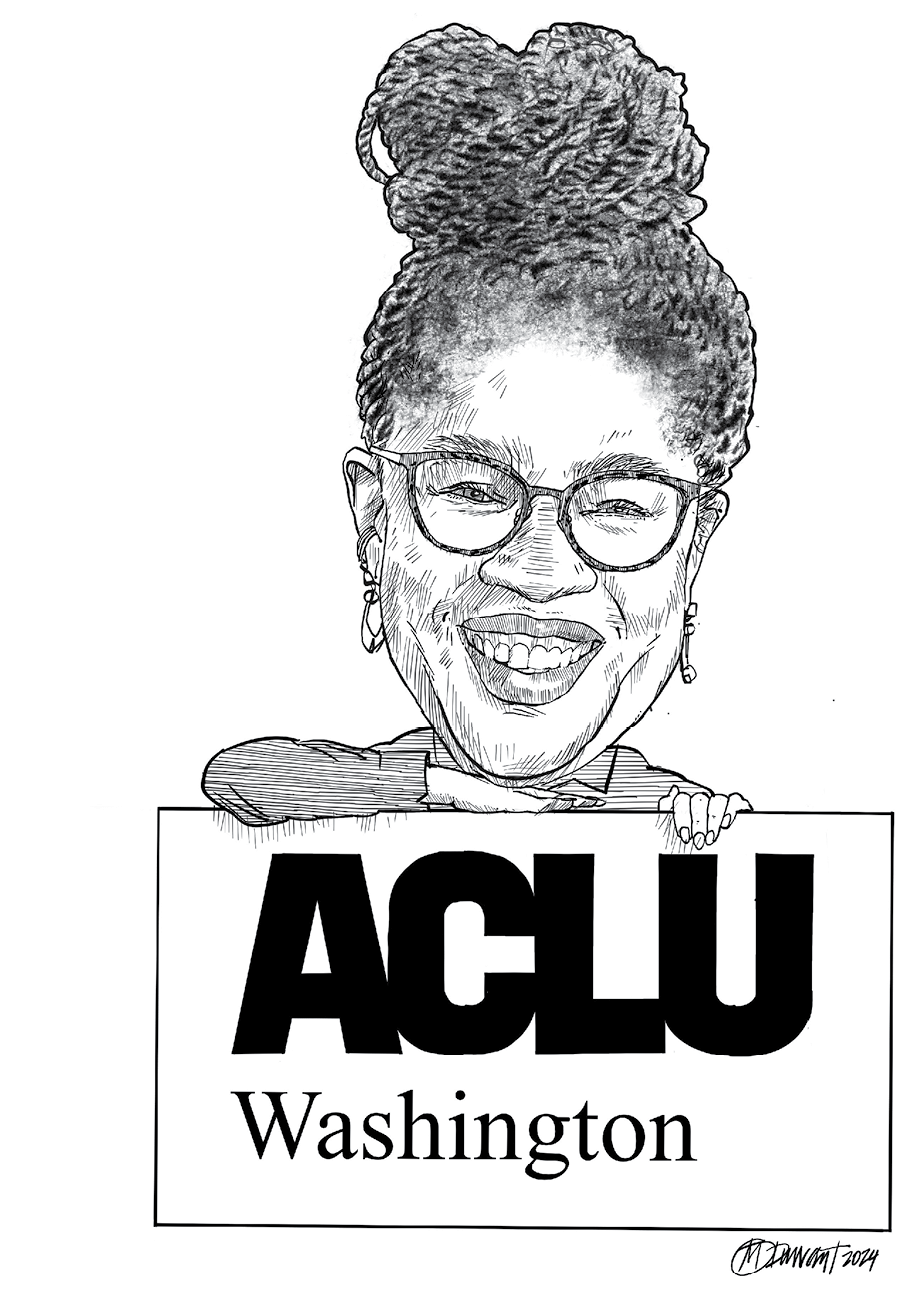
 Profile / Michele Storms: The Strength of Our Stories
By Julie Davidow
Michele Storms did not set out to become a lawyer.
Then she spent a summer during college volunteering at a shelter for unhoused women and children in Washington, D.C. The shelter’s ethos revolved around community. Everyone lived together — the people seeking housing and services and those providing them. They played with the children together. They shopped for food together. They cooked together. And they listened to each other’s stories.
“Because of that proximity,” says Storms, Executive Director of the ACLU of Washington, “I spent hours talking to these moms about their circumstances. I learned how the women got to where they were and what had happened in their lives.”
Bryan Stevenson, Founder and Executive Director of the Equal Justice Initiative, stresses the concept of proximity to emphasize the importance of hearing directly from those impacted by unjust systems. Although she wouldn’t have used the term to describe her experience during the 1980s, this proximity to people’s lives and stories inspired Storms to drop her previous goal of writing and producing films and television.
She grew up performing as an actress and singer in school plays and local theater in San Francisco. But the women’s stories at the shelter — so many of which hinged on a spiral of poverty precipitated by domestic violence or sexual harassment — changed Storms’ path. Combined with what she knew about her own family’s history of trauma, poverty, and gender-based violence, Storms began to see these individual experiences as part of a collective systemic injustice.
“That’s why, for me, justice, democracy and rights are rooted in stories,” Storms says. “They’re rooted in people. They’re not abstract concepts. People are trying to survive and there is no reason why everyone can’t have what they need.”
Using the law, Storms intended to challenge and ultimately change the systems that excluded and discriminated against so many. Her new goal: Become a civil legal aid attorney.
She hasn’t stopped working for social justice and civil rights since. After graduating from Gonzaga University School of Law in 1987, Storms worked at legal aid service organizations in Washington, including the Northwest Justice Project, Columbia Legal Services, and Evergreen Legal Services.
At the University of Washington School of Law, Storms was Assistant Dean for Public Service and founding Executive Director of the Gates Public Service Law Program. In 2016, she joined the ACLU-WA, where she spent two years as deputy director before becoming Executive Director of the organization in 2019.
Storms has also served on the Washington State Access to Justice Board, the OneAmerica Board of Directors, and as board member and secretary of Management Information Exchange.
One of her proudest achievements, Storms says, is the impact she had on law students and young lawyers during her time at the UW. Her favorite part of her own law school experience was working in legal aid clinics, offering representation to people who otherwise would not have been able to afford a lawyer. She liked being of service, but also realized the clinics had limited capacity. She carried that experience into her own teaching career, impressing upon law students the importance of giving back.
“For me, the law is a tool, above all else, in service of people,” Storms says. “I have students who told me one of the first things they did in their practice was start doing pro bono work because I hammered it into them.”
Storms has received numerous honors for her service to the legal profession and social and racial justice, including the 2019 Betty Binns Fletcher Leadership and Justice Award by Mother Attorneys Mentoring Association (MAMA) Seattle. She was also named Outstanding Lawyer for 2018 by the King County Bar Association. In 2016, The Washington State Bar Association and the Washington State Access to Justice Board awarded Storms the Norm Maleng Leadership Award. In 2008, she received the Staff Person of the Year Award from the University of Washington Law School Student Body.
In 2023, Storms received the Charles A. Goldmark Distinguished Service Award from the Legal Foundation of Washington. She accepted the award with a call to action aimed at herself, those in attendance and anyone in the legal profession. She implored them to use their privilege, access, and resources to build a more equitable legal system and society.
“Listen to and join forces with those most impacted — don’t seek to lead but, rather, offer your support,” Storms told the audience. “Then, and only then, take action. Speak up, keep righteous anger alive, for so long as people are suffering, choose not to look away.”
During her time at ACLU-WA, Storms has watched threats to democracy mount as voter suppression efforts gain strength nationwide and trust in democratic institutions falters. She has guided the organization’s emphasis on racial justice and criminal legal reform in the wake of George Floyd’s murder by police and what appears now to have been a short-lived and underwhelming nationwide racial reckoning.
ACLU-WA has an important role to play, Storms says, in safeguarding and expanding civil rights and civil liberties for everyone and, in particular, those who have been historically and systemically denied their rights.
To that end, Storms points to ACLU-WA’s recently launched Program Plan, which sets out the organization’s goals for the next five years. Undoing historic injustices is central to the plan’s focus in four areas: the criminal legal system, racial and economic justice, individual and personal rights and autonomy and democracy.
Storms acknowledges that undoing systemic inequality is hard, often disheartening and exhausting. After all, she says, the systems being challenged were designed to wrest power for the few at the cost of the many. That’s why she is committed to a workplace culture at ACLU-WA that makes space for rest and celebrates everyone’s role in building a more just and equitable society. One of Storms’ guiding principles is no one can do anything alone. Troubled by the state of affairs in this country and around the world in which people are starkly divided and often seemingly unconcerned about the humanity and survival of others, Storms notes that the antidote is grounded in community values of collective care, listening, bridging across difference, and protecting each other.
“It’s important to honor the place each of us has in this broader work — Michele believes that deeply and that’s how she leads,” says Vanessa Hernandez, ACLU-WA’s Integrated Advocacy Director. “Her support for a vision of collective strength emboldens ACLU staff to do the work of centering and building community power.”
Storms also holds tight to activist and writer Mariame Kaba’s notion of hope as a discipline — one that is sustained by action in the face of setbacks as well as victories.
As the 2024 state legislative session wound down last month and it became clear that many of the ACLU-WA’s policy objectives would not pass, Storms offered a message to the staff highlighting the groundwork laid for future successes and the long view of a struggle for equity and justice she’s been fighting since returning to campus from her summer at the D.C. shelter:
“If we are wise and if we are disciplined,” Storms wrote, “I believe that we will not measure victories in bills passed or lawsuits won — we will measure victories in our progress towards building an equitable future in which all are free.”
For Storms, that progress is often measured in small moments of community — moments that echo her experience as a college student four decades ago.
Recently, she received a card from the Washington Coalition for Police Accountability, whose members include people negatively impacted by policing as well as advocates. The card had a photo of the group’s members posing with House Speaker Rep. Laurie Jinkins on Advocacy Day in Olympia. Their note thanked Storms for ACLU-WA’s support, for working with and in community to lift up their efforts to hold police accountable and pursue racial justice in the criminal legal system.
“That just makes me so happy,” Storms said. “To know that the talented staff at the ACLU-WA can use their amazing legal acumen and advocacy resources to support the efforts of people who are directly experiencing the negative impact of systems we seek to change: That is everything.”
Julie Davidow is the Media and Communications Strategist at ACLU of Washington and can be reached by email at jdavidow@aclu-wa.org.


