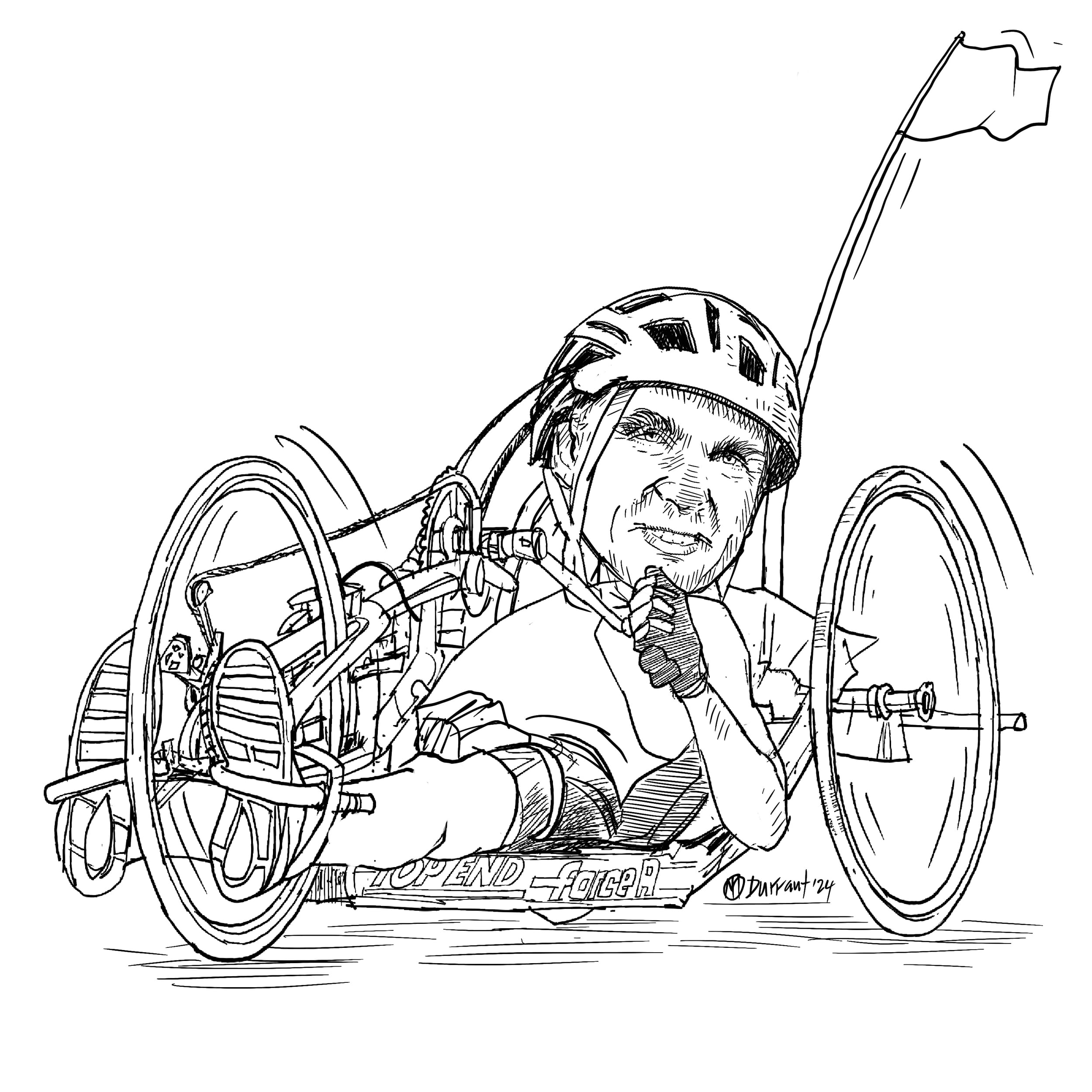
 The Foster Garvey corner office of Tom Ahearne is an exhibition of adventure, bold living, and risk-taking. Reminders of his bowhunting adventures hang on the wall — heads of Washington deer, Wyoming antelope, and Montana Bison — along with action photos of his motorcycle racing and snowboarding stunts.
But that life ended on February 11, 2014, when his T12 vertebrae burst upon landing a snowboarding flip at Stevens Pass — shredding his spinal cord, causing serious internal bleeding, and permanently paralyzing his legs. By luck, a medevac helicopter happened to be in the area to rush him to Harborview in time to save his life. Surgeries took months, and now the exercise and physical therapy sessions needed to maintain his spinal system take over 20 hours a week.
The post-accident photos in his office transition to marathons he has completed on the tricycle he arm-pedals in long distance bicycle events like the 206-mile Seattle to Portland (STP) race and mile elevation gain races like the Mount Baker Hillclimb and his Ride the Hurricane performance posted on a 2023 YouTube video.
I wanted to write this article because, even after Tom’s near-death experience left him half paralyzed, he has bravely carried on with his dedication to the law and the underprivileged people it serves. For example: continuing to argue the ongoing McCleary enforcement proceedings in the Washington Supreme Court1 months after being released from Harborview. First argued in 2011, that case continued until 2018 with annual Supreme Court proceedings to compel the Legislature to provide the additional $6 billion it promised towards its “paramount duty” to fund our public schools. Whenever I see Tom — e.g., as he chairs the KCBA Appellate Section — he has a smile on his face and enthusiastically handles the job at hand.
Importantly, I also wanted to understand more about what it takes to be a disabled member of the bar. I was amazed by the career of Cyrus Habib. Fully blind since age eight, he practiced at Perkins Coie for eight years, became a state legislator, Lieutenant Governor, and then Jesuit priest. Or Rajeev D. Majumdar, our WSBA President from 2019 to 2020, who wrote about his mental health crisis and depression. Noting that he had not sought help for so long because he thought it would make him seem weak, his only regret was that he had not sought help sooner. Our WSBA and the ABA have since 2015 focused on lawyer wellness — both physical and mental. Our profession prides itself on giving help. As a profession we also have an obligation to make asking for help acceptable and noble.
Somehow, I thought being paralyzed meant you had no further pain associated with the injury. Not so. “Most patients with injuries to the spinal cord or central nervous system suffer from excruciating, unrelenting, chronic pain that is largely resistant to treatment.” 2 Tom is among those unrelenting-pain victims. And trying to keep muscles and joints working despite the paralysis imposes further challenges — which is why Tom must endure over 20 hours of physical therapy each week. There is no day he does not experience severe pain — but he strives on and accepts it simply as a cost of living.
For example: on March 14 of this year, Tom argued the Wahkiakum School District v. State Supreme Court case — needing his son, John Tye, to help lift him to stand at the “all rise” command. The Court characterized the question as “Are school capital costs included in the ‘education’ that the State is required to fund under art. IX, sec. 1?” And in September the Court answered “no” 3 — a blow to children in school districts whose voters routinely reject local school funding measures. “Any school program reliant on local funding is inherently inequitable, he [Ahearne] argues, because less wealthy residents can’t contribute as much as the more affluent. The upshot: Children who live in low-income areas are shortchanged.” 4 Tom says his next suit will have to remedy that inequity.
School funding, however, is only one of Tom’s legal pursuits. His over 35 years of trial and appellate experience include high profile constitutional, statutory, and election related litigation; representing cyber victims; and coverage claims against insurance companies. A colleague, Dale Kingman at Gordon Tilden Thomas & Cordell LLP, also has an insurance coverage practice. He reports that what has consistently distinguished Ahearne, both before and after his disability, is his impeccable integrity and humility — Tom cares about the general good and has grace and a touch for the common man.
Steve DiJulio, who has practiced law with Tom for over 35 years, notes that “passion” may be an overused word — but not for Tom. Tom always approaches his work with passion, whether fighting for public school funding, for racial justice through the NAACP, or protecting citizens’ voting rights.
Knowing it’s sometimes a sensitive subject, I asked Tom what term he uses for his disability. He matter-of-factly answered “crippled” — a succinct description he does not personally consider pejorative.
And he quickly added that his disability opened his eyes to a reality he never saw before: “The contrast between how others treated and included me before my accident versus after is like day and night. . . . While cripples are not part of the prevailing DEI triad of race/gender/orientation, our daily on-the-ground experiences directly relate to our legal system’s lack of diversity, equity, and inclusion.” Citing the song “Relate,” he said he can’t really know what it’s like to be Black — just like others can’t know what it’s like to be crippled — but as that song says, “we’re really all the same . . . just in different kinds of ways.”
And that was his motivation to run for the Board of Governors. He said, “WSBA talks the DEI talk. But we need to now walk that talk.” His campaign statement on LinkedIn explains his belief that the “main thing” for WSBA is the critical role lawyers play to ensure our legal system protects all people equally. “That’s why I believe ‘diversity, equity and inclusion’ means something critically important. It’s not a slogan to say. It’s what each of us needs to constantly, consistently and relentlessly live.”
Judge Robin Hunt (retired) is a Bainbridge-friend of Tom, and notes as just one example that “Tom is propelled to ‘level the playing field’ for local Suquamish Tribal high schoolers by seeking to organize and coach a YMCA Mock Trial Team at Chief Kitsap Academy.”
Tom describes himself as an “Air Force brat” who grew up in nine states. He received his J.D. with honors from the University of Chicago after graduating magna cum laude from Notre Dame (Economics B.A.). He has repeatedly received honors and awards for his legal achievements, and particularly his service to children and public education. Over the years he has been a leader in diverse activities including the NAACP, King County United Way, and Democratic National Convention delegate. At home on Bainbridge Island, he has served as Planning Commissioner, Transportation Commission member, soccer coach, and school district disability educator.
As for Tom’s family, he proposed to his “unbelievably tolerant wife, Saint Mary Beth” on the top of the ferry Walla Walla. Born and raised in Lexington, Mississippi, she graduated from the University of Mississippi and met Tom when they both worked in Houston. She was a teacher until the birth of their first child in 1997 — and Tom credits her for the reason their children, Ashlen and John Tye, have turned out so “wonderfully.” Ashlen is a political science graduate student at Seattle University. John Tye is a University of Washington engineering grad currently working as a marine engineer. Tom concluded that the love and caring of the three of them is what has allowed him to live, despite his daily disability ordeals, a life of joy.
1 McCleary, et al. v. State of Washington, Supreme Court Case Number 84362-7
History of decision and subsequent orders at https://www.courts.wa.gov/appellate_trial_courts/SupremeCourt/?fa=supremecourt.McCleary_
Education
2 National Library of Medicine Abstract https://www.ncbi.nlm.nih.gov/pmc/articles/PMC3560294/#ref-list-a.k.atitle
3 Wahkiakum Sch. Dist. v. State, No. 101052-4. https://www.courts.wa.gov/opinions/pdf/1010524.pdf
4 Seattle Times Editorial: “Abandoning WA students to learn in cold, leaky schools is disgraceful,” March 17, 2023


